Family dynamics are an eternal source of conflict – as perennial as death and taxes. But when it comes to mother/daughter or sister/sister dynamics, that’s something that the Arts have explored exponentially in the last 60 years or so. Notable examples include Gillian Flynn’s Sharp Objects (which was made into an HBO series), and showed the tensions between a woman, her mother and her younger sister when she returned to her childhood home in smalltown America for a work assignment. But while the likes of Tracy Betts’ August: Osage County show the effect of a vitriolic matriarch on her daughters, as well their husbands and children – for most people ‘ugly’ family scenes are ‘smaller’, but spread over a longer time span…
Written and performed by Crystalia Varelis, Controlled Burn could be said to have adopted a Rashomon-style structure, with the audience seeing the same situation and period from the perspective of three family members. Framing the play with a narrative of wildfires in the American Southwest, the metaphor of burning and the other allusions representing deep truths are littered throughout the play.
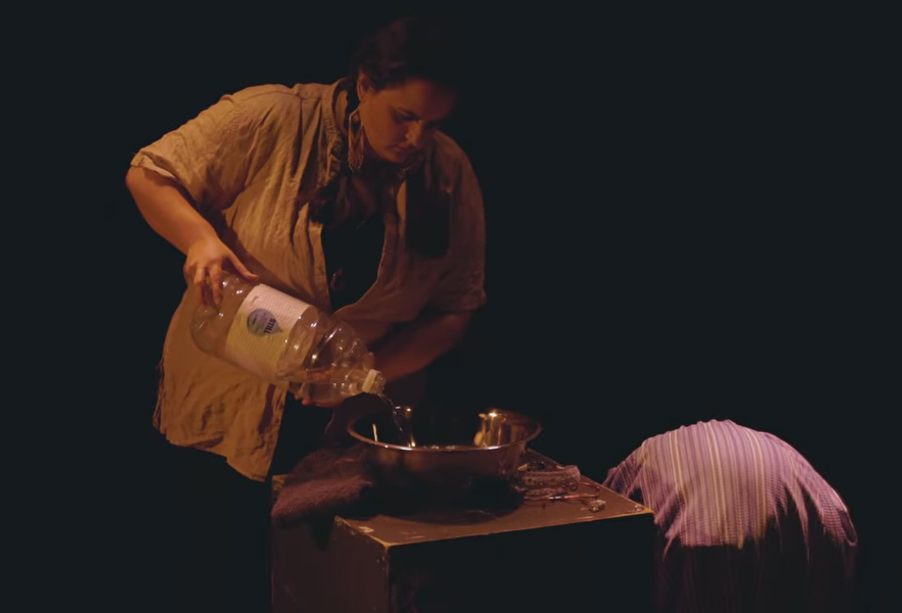
The first character that the audience meets is Niki. While the radio warning about the wildfires is broadcast, she pours a large bottle of water into several bowls. In a dim light, it looks ritualistic and symbolic, as well as reminding us of the zodiac sign Aquarius – the water bearer. Traditionally, the traits of Aquarians are that they are independent and progressive, though sometimes they can come across as emotionally detached or stubborn. This fits in with Niki’s sister’s opinion of her, but I’ll come back to that later.
While Niki speaks to the audience, she has lots of yarn that has become tangled and full of knots. As she talks about the yarn and its correlation to tree roots and connectivity, we sense that she is alluding to something much more personal and that the need to be ‘free’ (while still connected) is something she’s wrestling with.
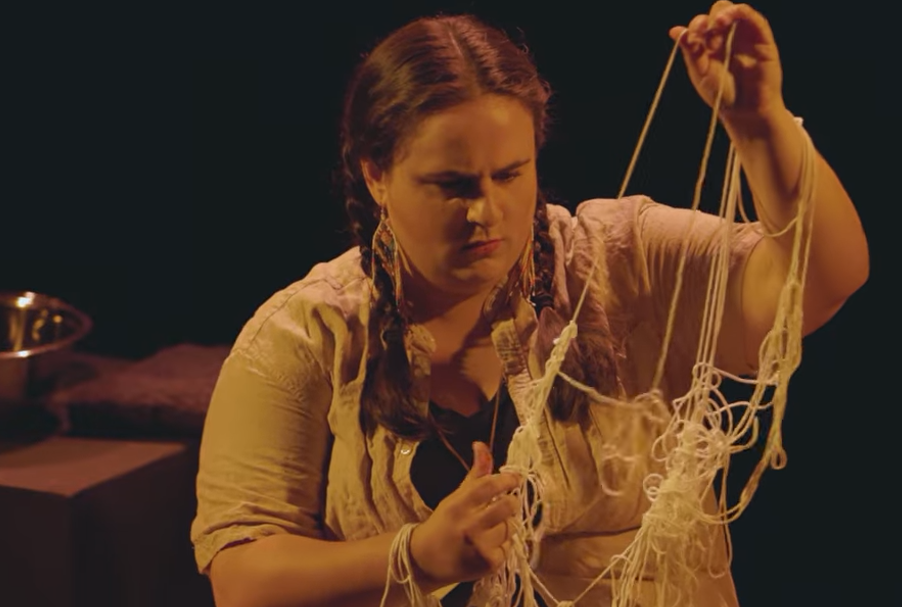
As for the title of the play, aside the aforementioned wildfire, it fits in with Niki’s assumption that fire is nature’s way of removing the detritus of existence, so that growth can begin anew – in other words, Niki’s mantra. But while Niki’s ‘epiphany’ has given her life focus, the conversations we hear with her sister Elena are anything but calm, as Niki reiterates that her ‘boundaries’ should be respected. Despite her sister’s protestations, Niki insists she will ‘not be dragged into’ the family drama or be manipulated by her mother to come home.
A lot of the phrases Niki uses sound like those on social media that have been lifted from psychology, and appropriated to describe the ‘toxic’ behaviour in others and the need for self-preservation. In today’s world “speaking my truth” has become synonymous with expressing one’s personal feelings. However, ‘truth’ as a concept isn’t a subjective, relative term and not dictated by emotions. If Niki had simply stated in plain language what her mother allegedly did and why exactly she was staying away, perhaps Elena wouldn’t contact her so often. We also sense that when Elena thinks Niki uses ‘psychobabble’ phrases that are repeated in ‘parrot fashion’, without an ‘ounce of reality’ to underpin what’s said. If Niki is uncompromising and ‘harsh’, Elena is the other end of the spectrum. Taking it upon herself to look after her mother with Niki’s departure, Elena is also pregnant. On top of this, Stavroula – her mother – has given Niki power of attorney to ensure that her do not resuscitate (DNR) order is respected.
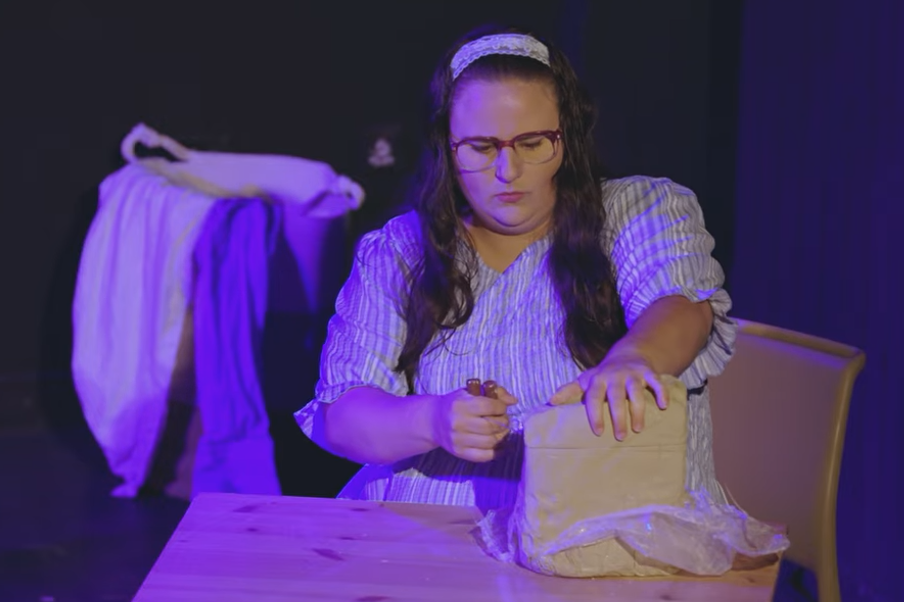
If Niki is vexed at Elena’s incessant calls and for ‘being wrapped around their mother’s finger’, Elena is equally frustrated at her sister. While she doesn’t understand Niki’s ‘selfish’ behaviour, Elena partially ‘rationalises’ her sister’s actions in believing Niki was jealous of her for settling down and having a baby. But for Elena, the deepest hurt is that she feels Niki ‘abandoned’ her as much as their mother.
But if unpicking knots out of yarn is Niki’s ‘go to’ activity for ‘keeping her hands busy’, for Elena it’s kneading out the air pockets and ‘imperfections’ of clay. This activity – in conjunction with Elena’s speech – simultaneously demonstrates Elena letting her aggression out, plus a visual aid for pummelling out ‘imperfections’.
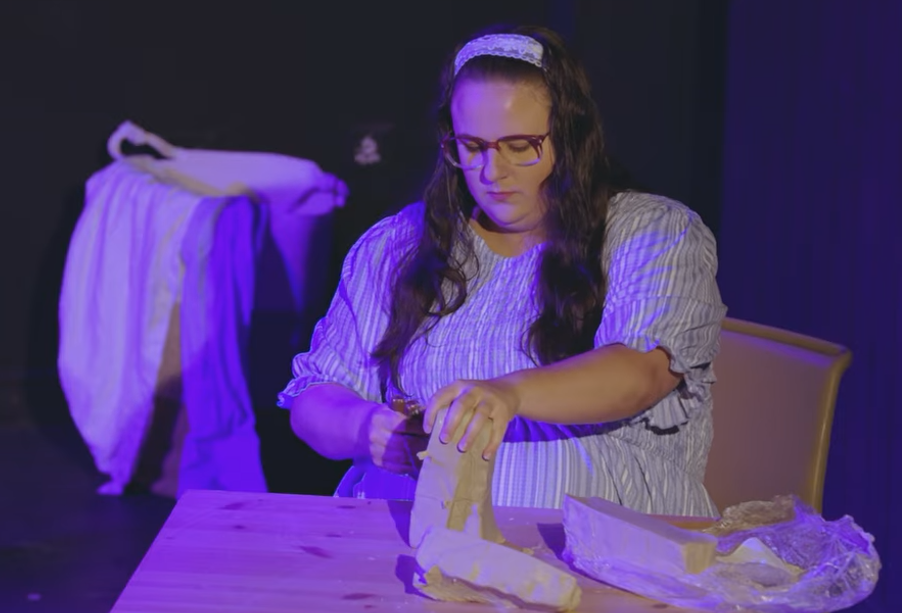
It has to be said, Elena’s discourse on planning and ‘making everything perfect’ is at the heart of her troubles. Having ‘loose’ goals are fine, but in the words of John Lennon: “Life is what happens to you while you’re busy making plans.” Elena has yet to adjust to the idea of accepting the things she can’t change, the courage to change the things she can, and the wisdom to know the difference…
As well as all this, there is dissonance in Elena’s thinking. At one point she states that Niki is like a rock (steadfast, immovable) while she is like a river (adaptable, not rigid). However, the frantic nature of Elena’s disposition suggests she is anything but calm or ‘fluid’. She isn’t, however, a ‘bad person’. She just hasn’t her own epiphany regarding the motives of her sister and mother. Which brings us on to Stavroula…
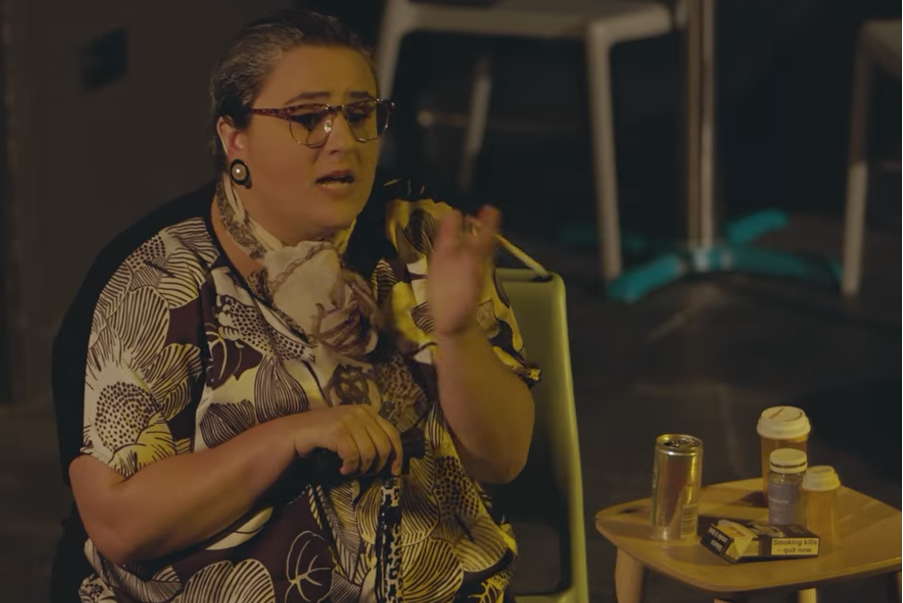
Before she speaks, Niki and Elena’s contrasting opinions of Stavroula leave the audience unclear as to her state of mind. The only common factor between the sisters is that Stavroula brings out the most intense feelings. What Stavroula has to say for herself is paradoxically surprising… and yet not…
Instead of firstly talking about herself or her daughters, Stavroula speaks about her own grandmother and her own memories of her when she was a child. The ‘skeleton in the closet’ – that the grandmother killed herself because following her stroke, she didn’t feel ‘of use’ to the family – is flatly denied by all, with the female family members owning the keys of censorship. As she reminisces, Stavroula remarks on the parallels between herself as a teenager and her present circumstances. While the play is vague about Stavroula’s exact medical condition, we know she has already undergone several operations and suffers from chronic pain. Just like her grandmother, Stavroula wants to face the end of their life on her own terms.
Stavroula’s disclosure about what she thinks about her respective daughters validates to some degree what Niki thinks about her. The ironic thing is that Niki has the same independent streak as her mother and that Stavroula can count on Niki’s ‘hatred’ to enforce the DNR order. Elena, meanwhile, is ‘cut from the same cloth’ as the relatives who denied Stavroula’s grandmother would ever consider taking her own life.
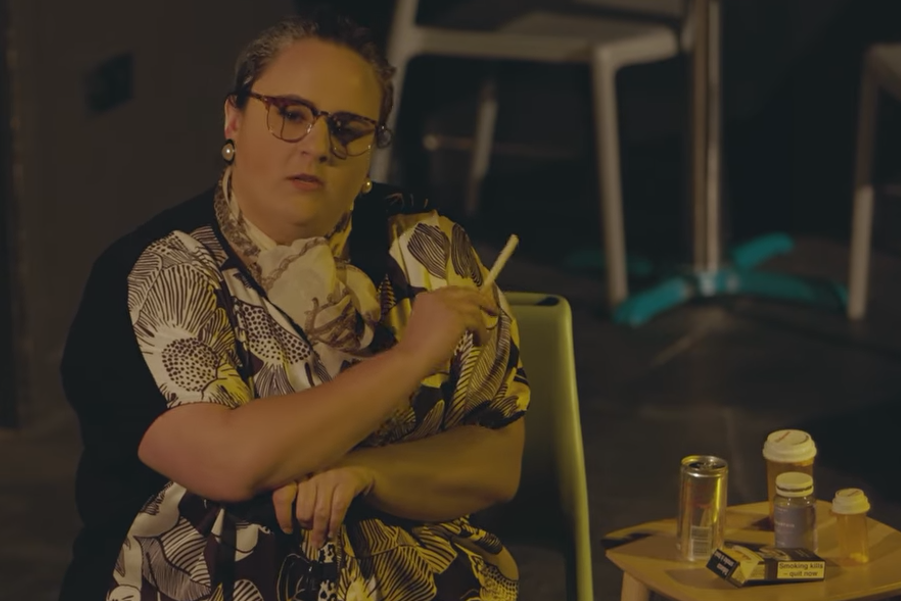
It occured to me while watching the play that most people have a passing knowledge of the Spanish language and that they know that ‘abuelita’ is the word ‘grandmother’. Varelis – an American of Greek descent – peppers the play with occasional Greek phrases that the family use with each other, lending the play a tone of authenticity and originality.
Another observation I had about the play is that even though all three characters are played by the same actor, in a ’roundabout’ way, the play adheres to the Bechdel test. Even when in the case of Stavroula, the mother – when she talks of when she was a child, she refers to her grandmother, sister and mother. While the presence of men isn’t ‘necessary’ in the play, it could be argued that their absence (and with it any logistical and emotional support they could’ve supplied) had made it necessary for the female family members to only rely on only each other in moments of crisis.
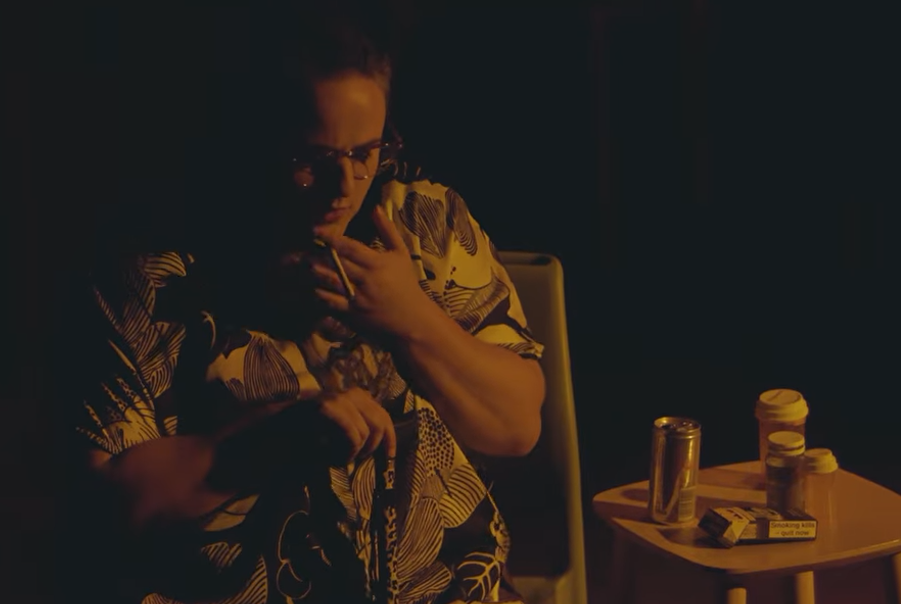
It could be argued that Controlled Burn’s characters conform to the tropes of female-centric narratives. Firstly there is Elena, whose reactions are very much rooted in her emotions, while also taking care of her mother AND mediating between Niki, Stavroula and herself. As the matriarch, Stavroula could be said to be ‘calculating’ and ‘thriving’ on the ‘friction’ she’s created between her daughters. While Stavroula to some degree doesn’t appear to care about what her daughters think of her, she knows Elena is ‘incapable’ of ‘staring into the abyss’ and ‘facing certain truths’, hence her choice of Niki to carry out her wishes. As for Niki, for all of her regurgitated self-help vernacular, she could really be said to be her own person. Unlike many women on social media, she eschews the approval and company of other women – even her own family.
It should be noted that all the characters struggle to find complete agency (though some have more success than others). Both Elena and Stavroula ‘need’ Niki for their own peace of mind, while Niki ‘needs’ her family to give her, her own space. In a roundabout way, they mirror the dynamics in Jean-Paul Sartre’s Huis Clos (No Exit), with each person in the trio making someone else miserable.
© Michael Davis 2026
Controlled Burn was performed at Camden People’s Theatre as part of Camden Fringe on 4th and 5th August 2026. Review is based on an official recording of the performance.

