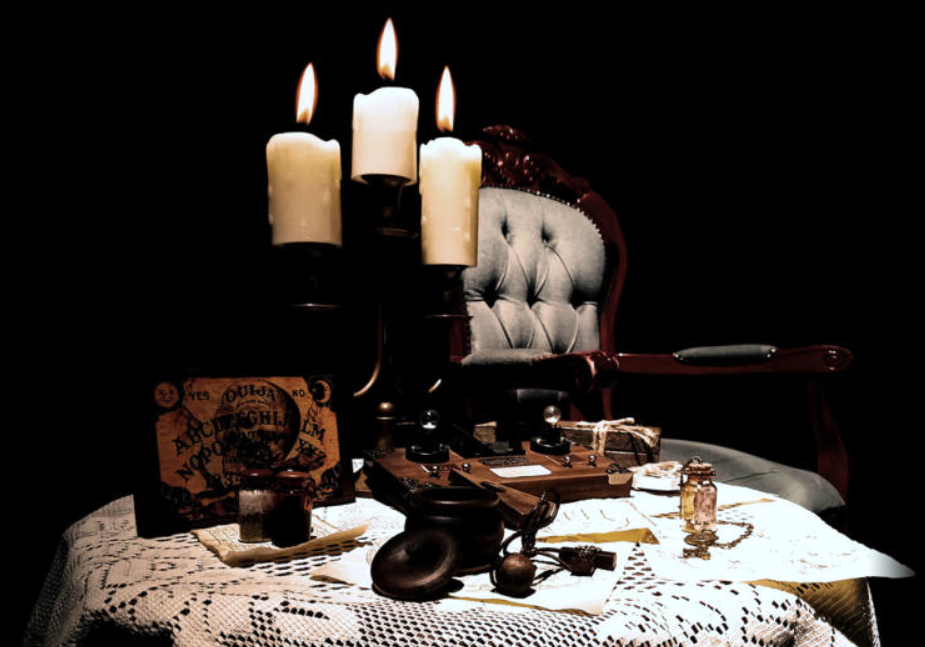
Dedicated to producing plays with a ‘Victorian’ flavour – adaptations of detective and horror literature that have a touch of the macabre – Don’t Go Into The Cellar theatre company’s latest show focuses on ‘folk horror’. Performed by writer/creator Jonathan Goodwin and dressed in the pre-20th century attire, the character of McLaird divulges to the audience three tales that deftly peel back the layers of the modern, rationalist world to reveal the primal fears that still reside in the collective unconscious.
As McLaird, Goodwin spends some time interacting with the audience – often with understated moments of mirth. But as the character of McLaird ‘gets down to business’, Goodwin takes on the personas of the characters who tell their ‘tales of woe’. McLaird as a character is Scottish and confident, so Goodwin’s shift to ‘Arthur Jefferson’ – a plain-speaking middle-aged accountant – brings a noticeable shift of energy to the proceedings.
The reason the first tale works so well is that as a character, Jefferson has an ‘everyman’ quality about him. Leading a ‘predictable’, conventional life and not enamoured with the hustle-and-bustle of ‘modern’ living, Jefferson’s stay at an out-of-the-way village is an ‘ambivalent’ experience in truest sense of the world. For while his ‘sensible’ and ‘rational’ temperament knows he should leave, Jefferson has just enough self-awareness to realise that he is bewitched by the presence of the enigmatic Elise and that in his heart of hearts, he’s happy to stay with her… forever…
In the second segment, McLaird has a closer ‘kinship’ with the source of the anecdote, as it stems from the experience of his colleague, Edwards. The framing ‘preamble’ of the trip to the pub and Edwards’ aversion to the nearby woods is arguably just as important to the enjoyment of this segment, as the main tale itself. An old nursery rhyme (that are often like fairy tales, diluted warnings of dangers lost to time) hangs over the Edwards’ tale, as the ‘Bacchanalian’ entourage of children passing by – simultaneously disturbing him and piquing his interest. But as is so often the case in folk horror, the locations that the ‘irrational mind’ knows are ‘no-go areas’ are (to quote Alfred, Lord Tennyson) where Nature reigns supreme: ‘red in tooth and claw’…

Closing the evening, the finale tale takes place in rural Wales. Interestingly, McLaird talks about another ‘authority’ on local folklore and his dealings with the more ‘innocent’ visitor, John Carfax. The notion of ‘outsiders’ feeling observed and possibly unwelcome is a common trope in folk horror, as well the other tales of the evening. But within Carfax’s segment, this notion is ‘doubled down on’, as well as notion of a parallel ‘community’ that chooses to subvert the ‘holy days’ for their own rituals…
As an anthology show, Folk Horror plays to the strength of a single actor performing several parts – bequeathing a sense of immediacy to the proceedings, as well as artistry in bringing different characters to life. It’s a testimony to Goodwin’s talent as an actor that all the characters he plays are distinctive and an organic part of the storytelling. Folk horror in general is fertile ground for exploring the oral history and superstitions of ‘forgotten places’, so it is an everlasting dark reflection of the past…
© Michael Davis 2026

Folk Horror ran at the Midlands Arts Centre on 30th October.

