For some, the ‘COVID years’ feel like the distant past. For others, it’s ‘triggering’, linked to the loss of loved ones and other painful memories. For all, it’s an experience that never will be completely forgotten. During that period, for the first time since the Second World War, the Government mandated specific behaviour from the population ‘for the safety of all’. And if the political discourse in the UK had been divisive over the previous 10+ years, the events from 2020 onwards exacerbated this exponentially…

Written by James McDermott – an established playwright and regular writer on EastEnders – and directed by Scott Le Crass, who recently directed the award-winning Rose with Maureen Lipman, Jab makes its UK premiere at the Finborough Theatre. This black comedy traces the highs and lows of a couple during the subsequent lockdowns and the knock-on effect on their marriage. Incidently, the play is inspired by the strained relationship of McDermott’s own parents during that period, but the issues it raises are universal, highlighting the cascading pressures that everyone was subjected to.
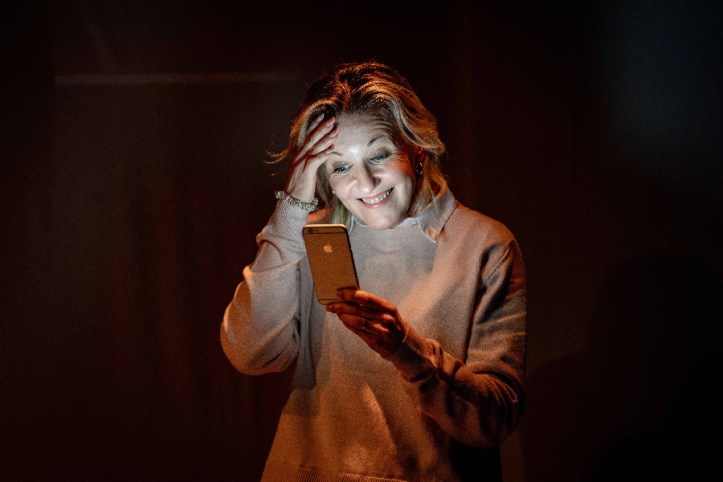
Kacey Ainsworth – who like McDermott is a former EastEnders alumni and also co-starred in 2023’s drama Leaves of Glass – plays Anne, a NHS worker. Her husband Don (Liam Tobin) is the proprieter of a shop that sells vintage items. Actually, it would be more accurate to say that Don mans the shop, a venture that has been losing money for years. The fact that Anne actually ‘owns’ the shop and covers the shortfall to pay for all the related bills, rates, etc is a sore point for her, along with the fact that despte being a painter when they first met, Don’s reluctant to paint any rooms at home or any DIY jobs that needs doing. Who has the ‘power’ in the relationship – pre- and during COVID – suffuses all conversations in the play to a greater or lesser extent.
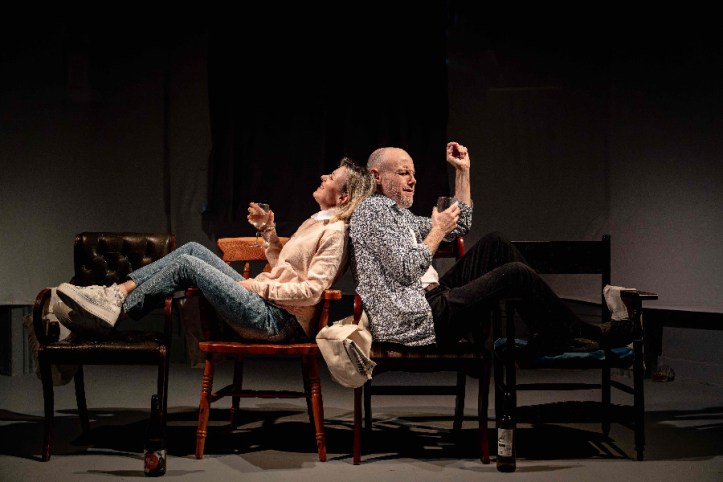
But before we see their relationship unravelling, we get a glimpse of happier times, their shared love of 80s music and dancing – a reminder of how they first met at a club in Skegness, before the cares of money and health reared their ugly head. We also see them watching television, reminiscient of Gogglebox. At the core of their relationship is the ‘banter’ – ‘non malicious bickering’ that adds ‘spice’ to their relationship. Drinking alcohol at home is a pastime at home for both spouses. At first, we see that they do it as part of their usual routine while they’re relaxing in the evening. But as time goes on, it becomes apparent that drinking has become a coping mechanism – a way to deal with the oppressive atmosphere indoors.

One could argue that Anne has every right to feel the way that she does about Don’s behaviour and their marriage, but much could be explained by the assumption that Anne’s fallen out of love with her husband and that the patterns of behaviour she overlooked in the past have now become unbearable. Having lost people’s she’s loved to COVID, she can’t understand why Don won’t get vaccinated – to protect himself and her.

But while Anne’s feelings for Don have changed, including the lack of interest in sex, he in turn seeks her approval and physical affection – which makes her reject him further… One of the interesting details in the couple’s backstory is that it was ‘agreed’ that as Anne earned more than Don and therefore the primary breadwinner, she would continue to work while Don stayed at home raising their young sons. This decision to make Don a ‘kept man’ would come to haunt both of them years later…
One of the things that came out of the pandemic was the discourse regarding ‘essential jobs’ and who ‘had to’ venture out to work to keep the country running. Of course what the salaries were for those who worked in hospitals and supermarkets is a subject for another time, but the main thing is Anne’s internalised this narrative as being an ‘essential’ worker, while pigeonholing Don as ‘not’. Had Anne not been on the front line and Don’s present job not deemed ‘a hobby’, perhaps she world have had a slightly different outlook on their respective ‘status’. But the catergorisation of ‘useful’ or not, of thinking of Don as someone she’s always one way or another had to take care of, are crystallised in her thoughts – and perhaps the events during the pandemic were the ‘straw that broke the camel’s back’.

By the latter part of the play, whatever differences and grievances the couple may have had to date are nothing compared to the betrayal that Anne feels, when her husband refrains from being vaccinated. The play could very well demonise Don’s actions, but given his medical history with heart problems and concerns of adverse effects of the hitherto untested vaccines (a conversation I had with relatives, one of whom did have an adverse reaction) it is a valid comment and one that seldom gets press.
But I digress.
As a the play reaches closer to the end, its vignette scenes come thick and fast. The ‘structure’ of the play may not be ‘satisfying’ compared to many plays based on fiction, but it does mirror not only the events of the pandemic, but also the fragmentation of many couples.
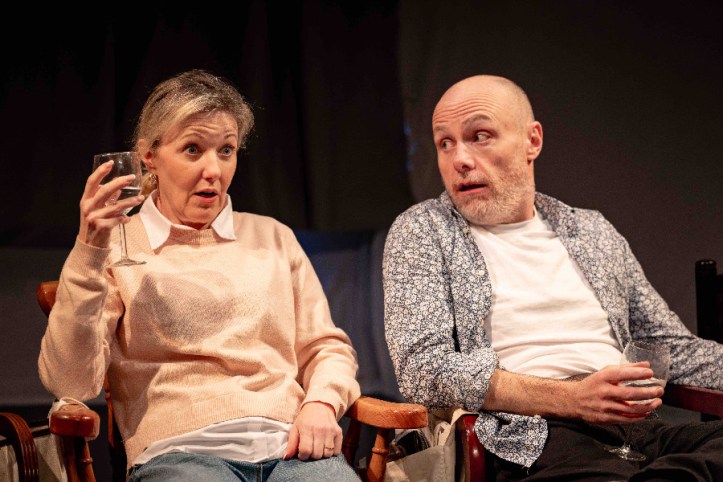
It goes without saying that Ainsworth and Tobin’s chemistry is delightful, effortlessly making the audience believe that they’ve known each other for close to 30 years and that beneath the banter and occasional harsh words, they still care for each other deeply – and we in turn care for them, faults and all.
© Michael Davis 2024

Jab runs at Finborough Theatre until 16th March.

