The last time the Royal Court Theatre showcased a play about three generations of women within the same family, it was in 2017 with Alice Birch’s Anatomy Of A Suicide. While in some respects a very different play, the Royal Court’s latest production – Cuckoo – as a dark comedy has traits and themes in common with Anatomy. It also shares one member of cast – Jodie McNee – who plays one of the principal characters.
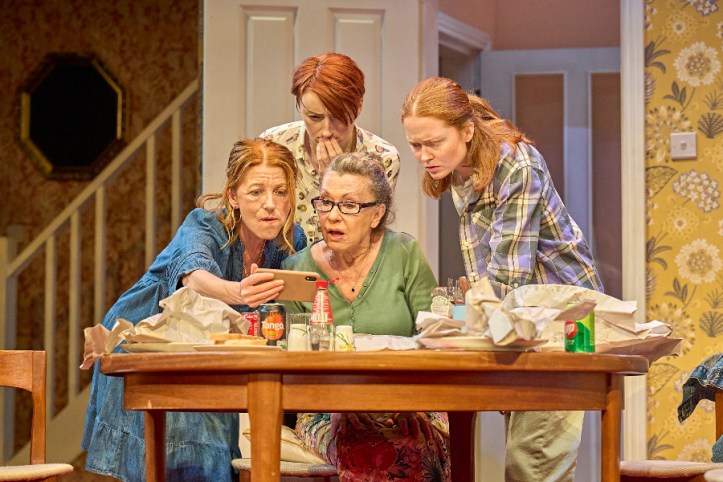
Written by Michael Wynne and directed by Vicky Featherstone, Cuckoo is set in Birkenhead, Merseyside, where we meet widow Doreen (Sue Jenkins), her two grown-up daughters Carmel (Michelle Butterly) and Jodie McNee (Sarah), and Carmel’s 17-year-old-daughter Megyn (Emma Harrison), as they eat their fish and chips. Much of the early part of the play revolves around the absence of ‘quality’ time and communication between family members, as each spends much of their time scrolling through their phones. It’s very funny and well-observed, but it’s only when Megyn mysteriously locks herself away in Doreen’s room for days on end that the meat of the play begins…

It could be said that nothing much ‘happens’ over the course of the play, but the same could be said for some of Pinter and Beckett’s plays. I would argue though that subtextually, the play is about the ‘enabling’ of behaviour. In recent years, on both sides of the Pond, we’ve seen politicians ‘getting away’ with all sorts of outlandish behaviour because their peers haven’t objected in any shape, way or form. ‘Closer to home’, a familiar story over millennia is how the behaviour of children is sometimes blamed on the indulgence of parents – exhibiting behaviour that would not be tolerated elsewhere. Certainly within Cuckoo, this is addressed from different angles: Doreen allowing Megyn to stay in her room indefinitely without protesting; Carmel initially objecting to the situation, then going along with it; and Sarah, as a schoolteacher, looking at things from the perspective of the law and the child as ‘victim’.
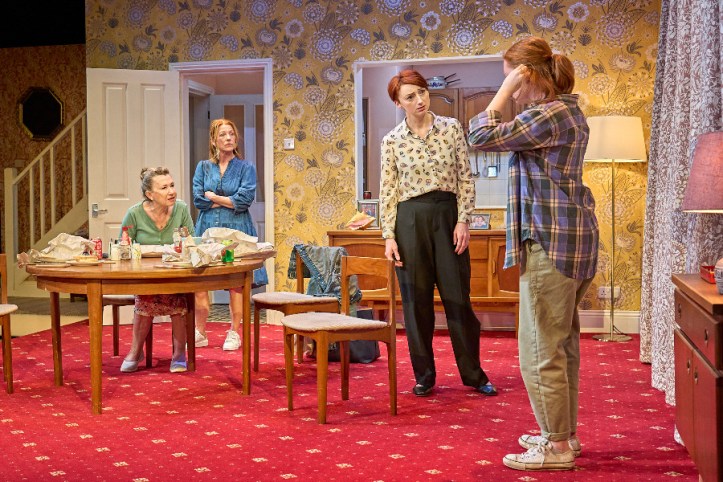
As Carmel, Butterly’s ‘dry’ comments has everyone in stitches and for the most part, the most relatable character in the play. Jenkins’ Doreen is also very funny, but while her non sequitur comments are amusing in their own right, they do hint that what the others are talking about is just ‘noise’ compared to what she knows… Much of Megyn’s behaviour is non-verbal, but Harrison conveys her moods ably. As for McNee, Sarah’s love life is a source of amusement in the play, but beyond the initial laughs, it proves to be a catalyst for showing ‘the truth’…
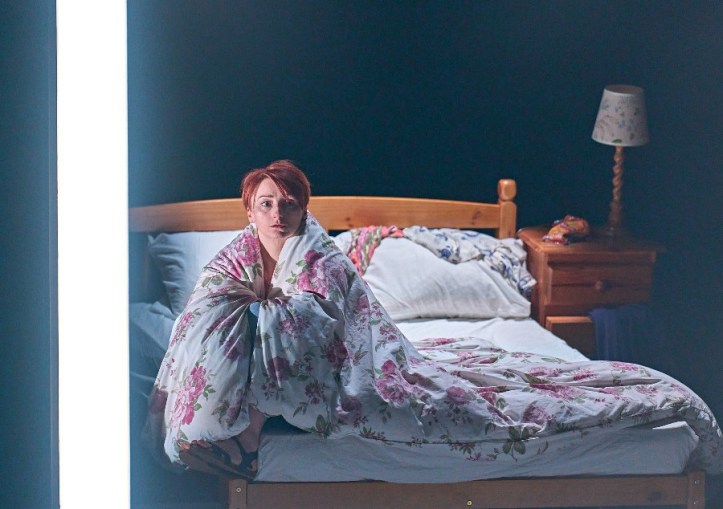
As well as having written numerous plays for the Royal Court in the past, Wynne also co-wrote My Summer of Love, a film that touched upon (among other things) strained familial relationships when both parties have ‘changed’. Cuckoo‘s silent denouement – which in some ways leaves more questions than answers – has echoes of Bryony Lavery’s The Believers, leaving the audience to speculate on the significance of what they’ve seen…
© Michael Davis 2023

Cuckoo runs at the Royal Court Theatre until 19th August.
 Breaking The Fourth Wall