Everyone who has ever made their name as a wordsmith (in the Arts) has at least one or more confidant to gauge their work – someone to offer encouragement, but ultimately a person who can point out options or areas where things can be honed or ‘improved’. Frank Whitbourn was that person for playwright David Wood. Over a span of nearly 50 years, they regularly stayed in contact by letter, with Wood sharing every aspect of writing, producing and directing shows for children. If the comparison can be forgiven for not being 100% analogous, Whitbourn was as influential on Wood as George Martin was on the Beatles. In many ways, Whitbourn was effectively a dramaturg before such a term or roles were commonplace.
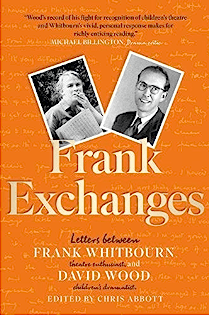 Having known Wood since his youth, Whitbourn bore witness to every aspect of Wood’s flourishing career, as he transitioned from actor to arguably Britan’s most successful children’s dramatist. During the Second World War, Whitbourn was seconded to Tehran, ‘Persia’ (nowadays located in modern day Iran) to ‘bring a bit of culture’ to the troops. Under his guidance, productions of some of Shakepeare’s most famous plays were showcased. But even when he was ‘demobbed’ and working as a teacher, Whitbourn as an ‘amateur theatre enthusiast’ nutured the love of stagecraft for pupils and community theatre groups alike. It is in this capacity that Whitbourn first met Wood.
Anyone who is familiar with theatre outside of the West End will no doubt know about Arts Council funding in the UK and how even with this provision, touring regional theatres is a precarious business. Wood’s correspondence with Whitbourn on this matter only serves to highlight that no matter how well-regarded Wood’s previous shows are by the public at large, there was no preferential treatment for Whirligig (his theatre company), no fast-tracking of grant awards. The show for each year was taken on a case-by-case basis by the Arts Council and when awarded a nominal sum, there was very little in the way of ‘buffer’ money for emergencies and the like. For many theatre companies, existing like this makes long-term planning next to impossible.
Something that was touched upon in one of Wood’s other books (Elizabeth Tayor’s Kiss and Other Brushes With Hollywood) was his experience of working with intellectual properties (IPs) of well-known children’s book characters. This is explored further in Frank Exchanges and as Wood shows through his experiences, working with IPs is a double-edged sword. Yes, there is kudos with working with such properties, but it’s ‘part and parcel’ with having less autonomy with the overall ‘shape’ of a show.
It is perhaps partly through the adaptations of many of Roald Dahl’s children’s books that Wood has made his name as the ‘national children’s dramatist’, with nailing down a variety of tones, as well as the logistics of conveying extreme height/minuteness or other effects through the clever use of stagecraft. While the technical aspects (to a degree) of shows are discussed in the correspondence with Whitbourn, I dare say Wood’s experience as a ‘magician’ in a former life kept him in good stead with the details that the audience notices versus what they don’t.
Whitbourn’s reverence for the life’s work of JM Barrie and the original, unsanitised version of Peter Pan shines through in numerous letters. As discussed in the book, Pan in its original form holds a mirror to children’s nature – showing them at their ‘best’, as well as their ‘worst’ too. Children know of this duality, but it is adults who are often afraid of admitting this. Small wonder then that with the exception of William Golding’s Lord of the Flies, that narratives ‘aimed at children’ dodge this challenge. Through all the letters, Wood shows a constant line of questioning regarding what age group a particular show is aimed at, what enjoyment will they glean as audience members and above all, treating children’s theatre equally as important as what’s produced for adults.
As the letters show, Whitbourn as a soundboard for Wood was invaluable. While still adoring theatre in all its facets, Whitbourn had his feet firmly ‘in the trenches’ – navigating the requirements of meeting the national curriculum, while at the same time, championing the ‘importance’ of the Arts with all the means at his disposal.
Whitbourn may not be a household name, but as this book shows, he left an indelible mark on those who knew him well. And just like the qualities described in Rudyard Kipling’s poem If, Whitbourn rubbed shoulders with ‘kings’ (or rather acting royalty) but never lost ‘the common touch’.
© Michael Davis 2023

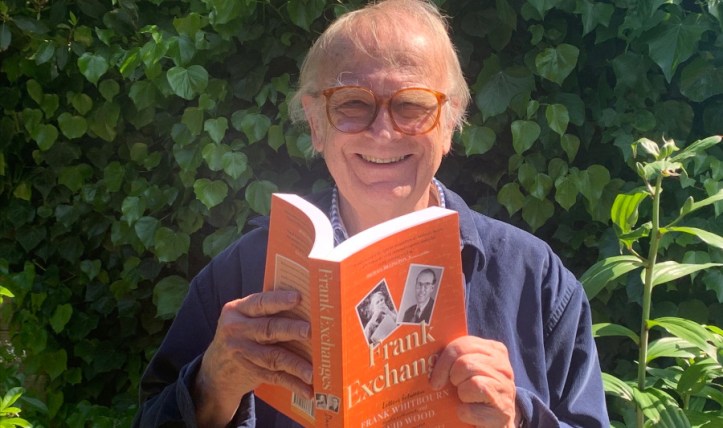
Frank Exchanges by David Wood (ed. Chris Abbott) is available to buy from The Book Guild Ltd, priced £12.99.

