An argument can be made for proposing Norwegian playwright Henrik Ibsen as the world’s most influential playwright (after Shakespeare). Certainly, as a contemporary of Freud, Jung and the nascent science of psychology, Ibsen was one of the first to utilise this dimension of human nature in the writing process.
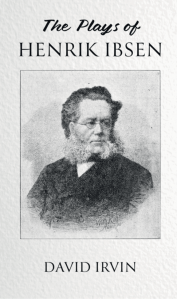 Author David Irvin has recently written a comprehensive tome, covering the length and breadth of Ibsen’s career. Covering the theatrical productions in chronological order, The Plays of Henrik Ibsen is perfect for anyone, regardless of how much or how little one knows of Ibsen beforehand. While I’m no stranger to Ibsen’s plays, I don’t claim to know everything there is to know about him and his plays. But having read Irvin’s book, not only did I learn plenty about Ibsen’s life and his less familiar plays, I’m sure I’ll be referring to it periodically as I delve into reading Ibsen again.
This book shows how every play Ibsen’s written builds upon the characters and themes that have been written before in his creative timeline and is a reaction against previous choices. For instance, in his early play Brand, the wilful, ‘virtuous’ protagonist is unbending in his principles and doesn’t make exceptions – even refusing to see his own mother and give her absolution. In contrast, the protagonist in Peer Gynt lets everyone down and his word is not to be trusted, but he does visit his mother on her deathbed and reminisces with her about happy times they had together in the past. In Brand, duty and one’s vocation triumphs over familial ties, but at what a cost…

Ibsen is known for social-realist dramas set in the 19th century, but as this book shows – before truly ‘finding his groove’ – Ibsen drew up the historical events of ancient Scandinavia for inspiration. While Ibsen found ways to subvert some expectations, the signature traits of his later plays (such as secrets, tensions and revelations butting against 19th-century bourgeois morality) aren’t present. This being the case, it’s fascinating to trace the evolution of his ‘voice’ amidst the creative missteps along the way.
Interestingly, in Norway at that time, plays were published ahead of any performances. This being the case, the plays that sold most in print (such as Brand) didn’t reflect those that most people came to see on stage and vice versa. Similarly, the plays that did very well at the box office in Norway (such as The League of Youth) are almost unheard of today, but those that were critically slated at the time (such as A Doll’s House and Ghosts) are now the most well-known. This book goes into all reasons for the U-turn in their critical appraisal.
While Irvin’s tome doesn’t go into great detail about Ibsen’s cultural peers, it does mention how James Joyce was a fan, as was George Bernard Shaw who produced his book The Quintessence of Ibsenism in the summer of 1890. Even ‘rival’ playwright August Strindberg on more one occasion begrudgingly acknowledged Ibsen’s cultural stature, while Sigmund Freud analysed Rosmersholm more thoroughly than any of Ibsen’s other plays.

If one looks at the individual plays of Ibsen – especially the most well-known examples – one could be forgiven for thinking that ‘truth’ and freedom’ are always of paramount importance and are a panacea for society’s woes. But as Irvin’s book shows, on close inspection on the breadth of Ibsen’s output, for every ‘ironclad’ principle, there are also times when perhaps they are not applicable. In the book’s chapter on The Wild Duck, it references a quote from Relling – a doctor in Ibsen’s play: “Rob the average man of his self-illusion, and you rob him of his happiness at the same time.”
In a strange way, both the absolutist and relativist views of marriage are present in Ibsen’s plays. Often Ibsen is labelled an iconoclast, who shines a bright light on the inherent foibles and hypocrisy in society’s institutions and ‘sacred cows’. But while plays such A Doll’s House and Hedda Gabler show unhappy wives and their attempts to circumvent their self-perceived constraints, plays such as Ibsen’s The Pillars of Society show a positive way forward. Within Pillars, Dina (the play’s ‘modern’ woman) makes a promise under duress to marry a controlling man. However, by the play’s conclusion she reneges on her ‘promise’, but agrees of her volition to eventually marry someone else – but not before she has worked and “become someone”. Thus, we see women having agency and a marriage on more equitable terms… Problems will always arise, however, if a couple are ‘unequally yoked’, don’t share the same core values and are ‘pulling in different directions’…

As for how Ibsen ‘came up’ with the conclusion A Doll’s House with Nora’s departure, this wasn’t a ‘flight of fancy’ from Ibsen’s imagination. This mirrored the circumstance of someone he knew – someone within his own social circle. While this isn’t talked about ad nauseum within Irvin’s book, this – and other examples in Ibsen’s plays where fact and fiction are blurred – are discussed, as are the role of the ‘muses’ in Ibsen’s work.
Ibsen is often labelled a feminist playwright, but as he himself stated when he addressed the Norwegian Society for Women’s Rights in 1897: “I thank you for your toast, but must disclaim the honour of having consciously worked for women’s rights. I am not even quite sure what women’s rights are. To me it has been a question of human rights… of course it is incidentally desirable to solve the problem of women, but that has not been my whole project. My task has been the portrayal of human beings.” Ibsen: first and foremost a champion of the individual…

Today, Ibsen is more popular than ever and any revival of one of his plays spurs a resurgence of interest within the culture sections of the broadsheets. At present, on BBC4/BBC iPlayer, its Ibsen season features film adaptations of some of his most influential plays, including Juliet Stevenson in A Doll’s House, Ingrid Bergman in Hedda Gabler, Diana Rigg and Anthony Hopkins in Little Eyolf, and Janet Suzman and Ian McKellen in Hedda Gabler. There have also been recent high-profile reimaginings that include Ewan McGregor and Elizabeth Debicki in the Ibsen-inspired My Master Builder, Alicia Vikander in Simon Stone’s The Lady from the Sea, as well as Nia DaCosta’s feature film Hedda. And of course who could forget Steve McQueen in An Enemy of the People? Nobody is going to forget about Ibsen any time soon…
© Michael Davis 2026

The Complete Plays of Henrik Ibsen is published by Troubador Publishing Ltd and available to buy from Amazon and Waterstones.
 Breaking The Fourth Wall