Ghost stories have a perennial appeal, especially at this time of year – a time when 21st century rationalism and scepticism is momentarily suspended and it is ‘all right’ to admit that “there are more things in heaven and earth… than are dreamt of in your philosophy” to quote Hamlet. The latest (and third) joint venture by theatre companies HighTide and Pentabus (in association with Harlow Playhouse) brings together four writers from the east and west of England to reimagine tales of dread for the 21st century, while at the same time imbue them with the flavour of rural England (or at the very least outside the major metropolitan areas). Local legends are an inextricable part of the folk-horror sub-genre. And while pagan/Wicker Man-esque signifiers aren’t present at all during the evening, the local oral history of unhappy times is palpable…
All four short plays are directed by Elle While, the BAFTA winning Artistic Director of Pentabus and performed by Keaton Guimarães-Tolley and Sarita Gabony.

Actors on stage ‘breaking the fourth wall’ to talk to the audience is a tried-and-test method for ghost stories, whether it is Christopher Lee reading MR James’s tales at Christmas or the meta play-within-the-play in the West End production of The Woman in Black. So how best to broach soliloquies in an original fashion? The evening’s opening play circumvents this conundrum…
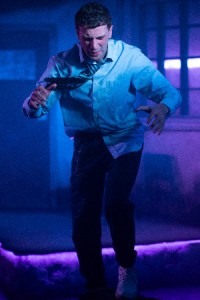 In The White Horse by Florence Espeut-Nickless, we first meet Guimarães-Tolley’s character in a pupil referral unit. As a troubled teenager, he is made to talk to a psychiatrist to get to the bottom of his problems and antisocial behaviour. I was immediately reminded of Alan Strang’s relationship with the psychiatrist Dysart in Peter Shaffer’s Equus (though I daresay some people might automatically think of Netflix’s Adolescence). But I digress.
Before the ‘meat’ of the play, Guimarães-Tolley improvises and interacts with the audience in character, which not only breaks the ice, but subliminally informs the audience about the true nature of the teenager, rather than just what he says later.

Both The White Horse and Simon Longman’s Cold Oak Lane (the second play of the evening) follow the trope of the outsider, who stumbles across grim events from the recent and distant past. However, particularly in Espeut-Nickless’ play, this is not immediately obvious, as the situations and developments in The White Horse recognisably belong to the present day.
While I “can’t” say much more about the rest of The White Horse without giving away the plot, I would say in my subjective opinion that the first play manages to be the most original piece of the evening, with an engaging performance from Guimarães-Tolley and arguably the most well-rounded play in execution. The White Horse also (obliquely) gives a nod to Nigel Kneale’s The Road…
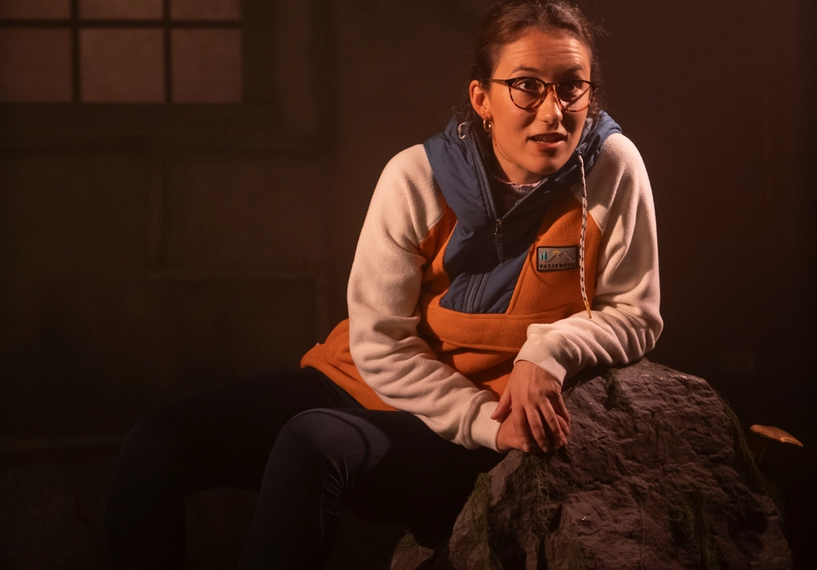
Longman’s Cold Oak Lane builds upon the notion that the psychological traumas of the protagonist reflect and inform the supernatural phenomena encountered in the narrative. Gabony’s botany doctoral undergraduate has to contend with a terminally-ill parent. Unable to face the inevitable, the undergraduate beats a hasty retreat to the other side of the country, under the pretext of finding a rare fungi for her thesis. But it’s only when she visits a pub in the vicinity that she finds out her presence there – away from her family – echoes an injustice from long ago…
As well as the botanist, Gabony also admirably performs the other characters in the second play. In many ways, Cold Oak Lane is a natural heir to The Woman in Black with its emphasis on tension, Anna Short’s top notch sound design and Jonathan Chan’s lighting.

The third and fourth play of the evening definitely belong together – focusing on those who are unhappy with their lot and who get more than they bargained for in the pursuit of their curiosity. Anne Odeke’s The Takeover find its protagonist (played by Guimarães-Tolley again) exploring an abandoned sea fort from the Second World War for his YouTube channel.

While it is very atmospheric, what sets The Takeover apart is the little bits of information we glean about the main character, even when things ‘go wrong’. We know that he has a girlfriend – Mandy – and from what we hear of her over the phone, isn’t a ‘wallflower’. We also know that even though he loves her, he doesn’t want to ‘settle down’ until his channel (which at present is a ‘hobby’) has become a legitimate revenue stream that they can live on comfortably.
Without giving anything away, the lighting and sound design plays a big part in the play’s atmosphere and for those of you who have ever watched Sapphire & Steel, will recognise the allusions to the war-torn past and present overlapping…

Closing the evening, Rosa Tarr’s The Consequence of Diving Lots finds its protagonist working nights at a remote storage facility. Gabony as the protagonist portrays a young, if overly inquisitive young woman, who makes judgement calls about the people who visit the facility. With no other means to get out the area, the possessions brought in are a constant reminder to her that local people’s lives have changed and in a transitional stage of ‘moving on’, while she’s ‘stuck there’…
While The Consequence could be interpreted as the dangers of envying other people’s lives and possessions, the play’s ‘Pandora’s Box McGuffin’ will leave the audience with many questions, including the ‘innocence’ of the protagonist…
© Michael Davis 2025

Even More Ghost Stories by Candlelight ran at the Midlands Arts Centre on 29th October. It continues the rest of its tour at:
Shakespeare North Playhouse, Prescot
30th October – 1st November
Box office: 0151 433 7156 / www.shakespearenorthplayhouse.co.uk
Battersea Arts Centre
4th – 8th November
Box office: 020 7223 2223 / www.bac.org.uk
 Breaking The Fourth Wall