While many people in Britain are familiar with the evacuation of children to the countryside on the outset of the Second World War and ‘kindertransport’ – a similar organised effort to transport refugee children to the UK from Nazi Germany – there have also been events that have shown the lack of care to pre-adolescents. Charles Dickens wrote about the workhouses for the orphaned and destitute, and many children were forced to work long hours in factories and mines. But if the treatment of these ‘unfortunates’ are viewed as something that was peculiar to Britain during the Industrial Revolution, sadly this is not the case.
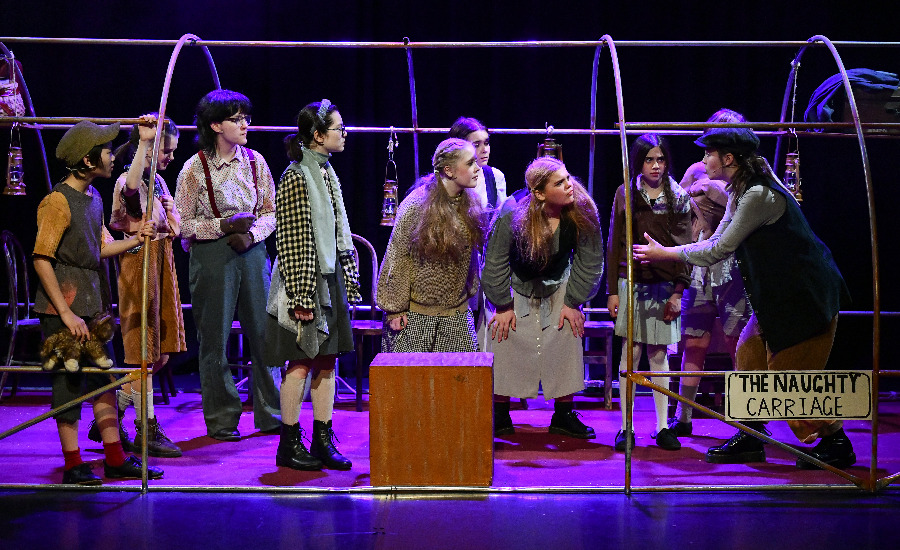
From the mid-19th century to 1929, ‘orphaned’ children from the Eastern Seaboard of the United States were sent by train to foster homes – primarily in rural areas of the Midwest. Without any screening of caretakers, or follow-ups on placements, many of the children were used as slave farm labour. With this in mind, is it even possible to make a positive, upbeat show about these chain of events? Written by Luke Saydon (music/lyrics) and Carl Miller (book/lyrics), and directed by the creative director of British Youth Music Theatre Emily Gray, The Naughty Carriage On The Orphan Train does ‘the impossible’.
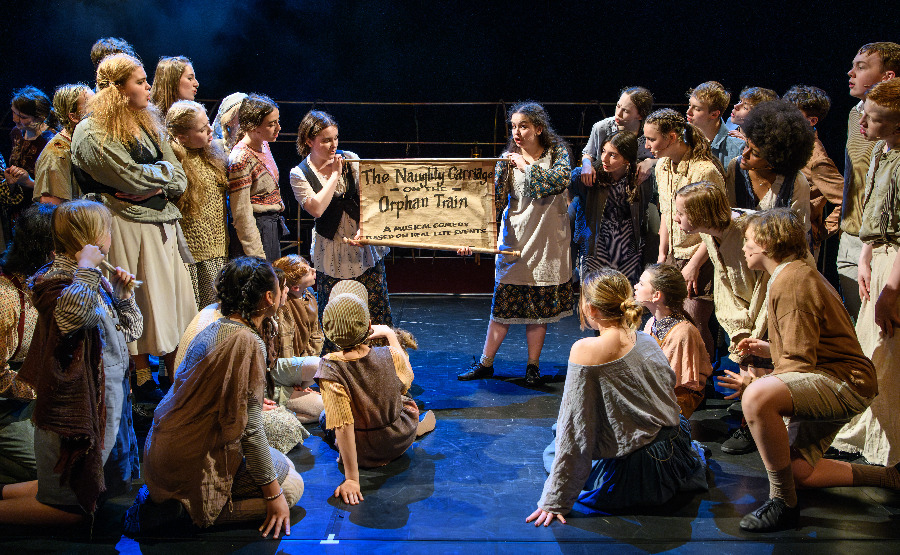
The audience is introduced to one group of children who have to make the trip westbound. While they are all of different ages, backgrounds and cliques, they’re all uncertain about their chances of finding new families. From amongst them, two teens are the most vocal about expectations. Champ (Blaize Middleton) is the optimist, and while her assertion that there is a family waiting for everyone, it could be argued that this is what she’s telling herself to keep her hopes up. Then there is Appoline (Eiry Shi). She’s been on the ‘orphan train’ a number of times before. Because she has seen the sort of children the ‘prospective parents’ pick (those that are visually appealing and/or look robust enough to carry out intensive/prolonged labour), she has a pragmatic understanding of who does or doesn’t have a chance of being chosen. Of course, there is a greater mystery regarding her true ‘status’ – something that historically wasn’t unique to her or the other ‘orphans’ at all…
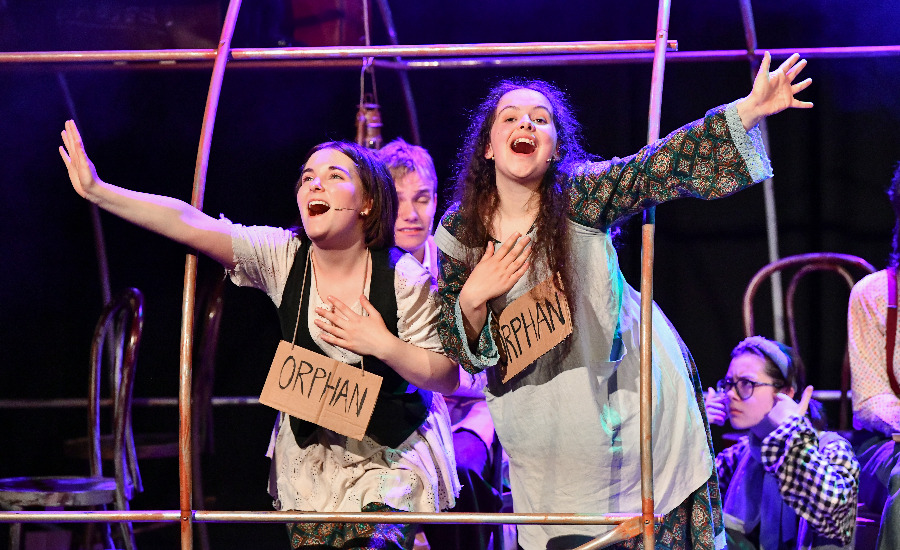
Through inference and song, the audience is made aware of the characters’ POV –that ‘family’ is transactional in nature and that belonging anywhere requires copious ‘hard work’. Obviously this flies in the face of how families should ‘operate’, to say nothing of unconditional love.
I must say at this juncture that the show is very ‘upbeat’ and while it touches on various serious issues, there is a deftness to how they are broached. In this respect, tonally Naughty Carriage is not too different from Lionel Bart’s Oliver! where cold hard facts and entertainment walk hand in hand.
For the much of the show, the ‘naughty carriage’ is a misnomer, as it only denotes the children who are left behind and not chosen. But it is only when all the characters realise that the new ‘parents’ they are searching for might not be the answer to feeling ‘complete’ that we see them ‘misbehaving’ and start to think for themselves.
While the show can be appreciated by people of all ages, the show’s theme of the quest for ‘completeness’ (which for adults can be applied to having a family of one’s own, the perfect job, or true love) is a malleable truth and lends itself to many interpretations.
© Michael Davis 2025
The Naughty Carriage On The Orphan Train runs at the Birmingham Hippodrome’s Patrick Studio from 25th to 27th April.
 Breaking The Fourth Wall