PREFACE: While ‘stripping’ as we know it today has been around for about 400 years, it first garnered quasi-legitmacy in 1940s Britain when stationary tableaux vivants were staged at London’s Windmill Theatre. This was to circumvent a British law that prohibited naked women from moving. The Windmill ‘girls’ would also tour other London and provincial theatres. Fast forward 20 years later and changes in the law in the 1960s brought about a boom of strip clubs – the most famous being those in Soho with ‘fully nude’ dancing and audience participation. Pubs were also used as venues, most particularly in the East End, with a concentration of such venues in the district of Shoreditch.

For the next 30+ years, there was friction between club owners and many different factions – local authorties who didn’t want such establishments in their wards, the media (who blamed them for all the social ills of the time) and the Metropolitan police ‘vice squad’, whose own diplicitous relationship owners between ‘enterprises’ in Soho can be read elsewhere. Fast forward again to the late 2010s and sections of areas like Shoreditch have been gentrified, erasing venues that had been in operation for several generations. The final nails in the coffin, however, were the days of COVID and their aftermath, when even after venues were reopened, the economy never recovered and former club patrons couldn’t afford to visit so regularly. Ironically, it wasn’t ‘moral guardians’ or even politicians (at least not directly) that closed down many strip venues, but the mishandling of the economy. The only ‘trickle down’ effect that had an immediate impact on club venues was the cash flow drying up…
__________________________________________________________________________________________
Dedicated to increasing socio-economic access of the Arts for those on- and off-stage, Lockdown Projections’ latest venture is a multilayered show that is on the one hand very ‘personal’ and rooted in the real-life experiences of women who have worked in strip venues in the past and on the other, looking at ‘the bigger picture’. One of these women is the writer and producer of Whiplash – Rachel Isobel Heritage – who started writing the play two years ago, in the middle of her now four-year tenure as a stripper. Initially embarked on as a means of financial independence as an adult, stripping helped her to start funding Lockdown Projections. And knowing the harsh economic realities that dancers at these venues face (which we’ll talk about later), this play is a labour of love for Heritage and a wake-up call for change regarding ‘club protocol’…

Directed by Saffron Woolven, with choreography by Luna Minxx, Whiplash is for the most part set in the present day, within post-COVID strip scene. It begins, however, several years ago, when a novice dancer named Nemesis (Hannah Cauchi) is thrown out of Olympus Gentlemen’s Club by manager Victor (Chris Agha), who firmly puts the blame of an ‘altercation’ on Nemesis. Years later, after she is hired by Charlie (Alessandro Woodbridge) at Olympus, we find that Nemesis working at the same venue again, albeit without the knowledge of Victor who is away a lot.

Also working at the club are many of the faces from the ‘old days’: Quinn (Phoebe Natasha-White), Kylie (Anna Roy), Chanel (Lauren Shotton) and Nikii (Rachel Isobel Heritage). While Nikii tries to keep Nemesis away from Victor when he’s around, Nemesis herself has taken Candy (Rosie Carson) – one of the new dancers, under her wing. The relative calm of the club is swept away, however, by not only Victor’s discovery of Nemesis, but by also the return of John (Gregor Copeland), the VIP guest who assaulted Nemesis years before…

At this juncture, it would be easy to assume that Heritage is painting all these venues as dangerous places and women who work there are as all ‘victims’. While Heritage doesn’t ignore the ‘bad things’ that sometimes occur, her answers are much more nuanced. Arguably influenced by the author Stacey Clare (The Ethical Stripper) – who herself worked for 10 years as a stripper before writing her critical analysis of the gig economy/contract work aspect of life as a ‘dancer’ – these insights find themselves throughout Heritage’s show.

Whiplash organically introduces how clubs actually earn their base level of income: all the dancers have to pay a substantial fee to the club to work that evening. The dancers therefore have to earn a fair bit before they ‘break even’, never mind make a profit. What this means is during the ‘down times’, clubs still earn a steady level of profit, but for the dancers, they only have enough to live on if the footfall at the club (along with private dances) reaches a certain threshold. The play also makes a distinction between how solvent prople are now (post-COVID) and how things were before.

Heritage is keen to point out (through the various characters) that there is a sisterhood of sorts among the dancers, a ‘family by choice’. There will always be money issues, but by having people in your life who are ‘in the same boat’ and who ‘have your back’, they are invaluable. There are also parallels in Whiplash with Nell Dunn’s play from the early ’80s – Steaming – where a group of women in the East End meet regularly in the local public baths, decide to fight its closure.

One other thing that has to be mentioned – which isn’t talked about ‘directly’, but suffuses the play – is sex-positivity. While the payment practices in the club are ‘less than ideal’, the women do enjoy the dancing and embracing their sexuality and the ethos of sex-positive feminism. Of course, advocates of second wave feminism don’t see it that way and the regular visits by a character played by Erin Patterson, may not be because she’s gay or interested in dancing herself…
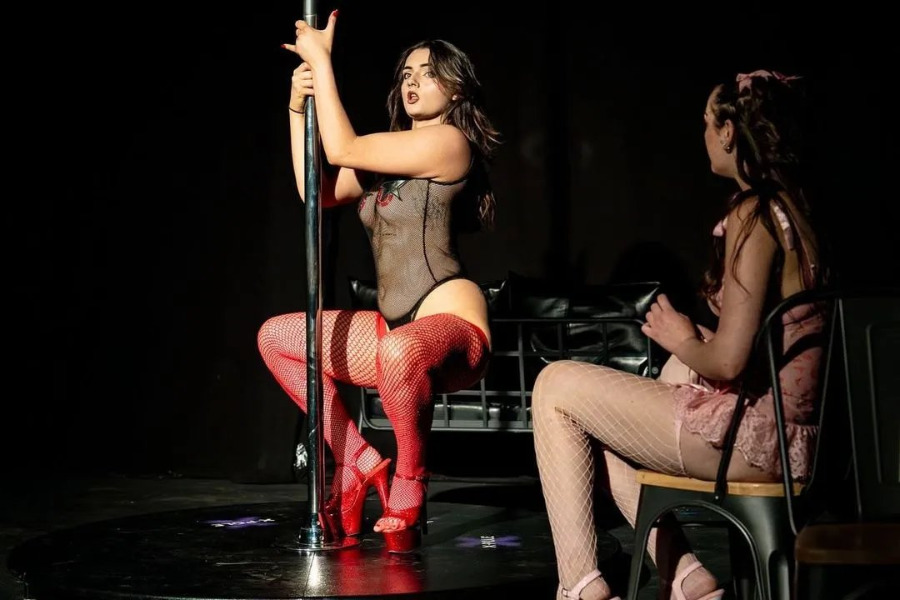
While the acting performed to a uniformly high standard, special mention should be made for Cauchi, Agha, Patterson and Heritage in their respective roles. Most of the actors taking part had no prior knowledge of pole dancing, but following their training with Minxx, proved themselves adept at this with all the required athleticism.

There have been a few movies to date (such as 2000’s Dancing at the Blue Iguana) that have avoided Hollywood’s usual depiction of strippers and treated them (and their private lives) seriously, but theatre (in the UK at least) still shys away from the topic, because of its stigma. Kudos then to Heritage, and the rest of the cast and crew of Whiplash for attempting to the broach this subject, incorporating the human touch with an understanding of the micro/macro economic forces that still prevail to this day. Proof indeed there is nothing too difficult or ‘taboo’ to stage, with the right, intelligent approach.
© Michael Davis 2024

Whiplash ran at the Courtyard Theatre from 14th to 17th August
 Breaking The Fourth Wall