Psychologists generally agree that contrary to the lipservice made by society, ‘lies’ are a necessary part of life. The omission of selected facts or the emphasis of certain things are an important part of politics, statecraft and corporate communications. On a personal level though, higher standards are expected of individuals and when it comes to relationships with our significant others, a deficit of ‘truth’ is seen as number one cause in the erosion of trust. Be that as it may, everyone tells ‘fibs’ – especially to spare the feelings of others or it is predicted that total honesty will sow greater discord…
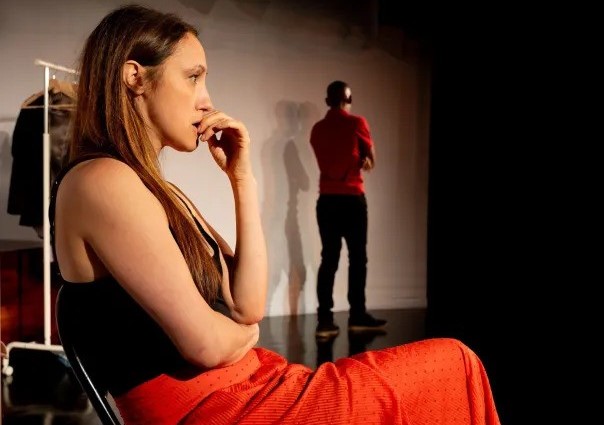
Written by Brian Coyle and directed by Jonathan Woolf, The Box begins with a potentially surreal premise – the aforementioned ‘box’ and the couple to whom it belongs to. As part of their roleplaying game which opens the play, Tom (Martin Edwards) and Kate (Sarah Lawrie) pretend to be other people meeting up for a date. One wonders at first whether this is a game to spice up the marriage. But as the play progresses, more clues are given for their ‘strange’ behaviour, as questions about how ‘normal’ they are surface, compared to other couples. In terms of roleplaying’s place within the narrative, one is reminded of Jean Genet’s The Maids and what the characters’ roleplaying actually portains to.
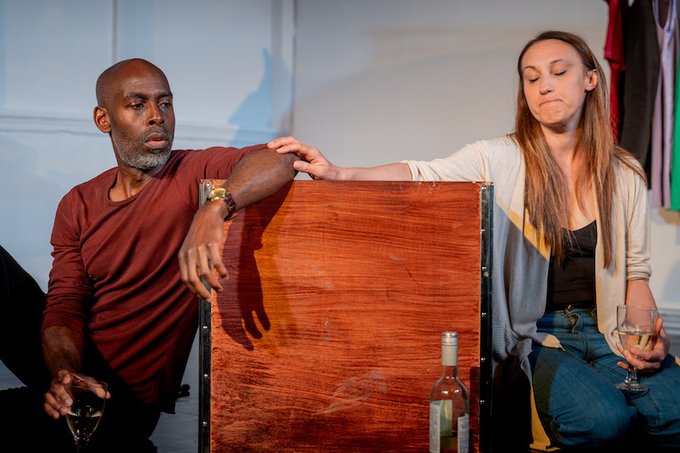
One important detail that is pivotal in the plot is Kate’s absence from work for almost a year. Following ‘the event’, Kate’s trauma has kept her away, leaving Tom to navigate (without much success) ‘the best course of action’ so that she’s on the way to recovery (or at the very least kept on an even keel). Judging by Kate’s comments about their wine (which she disparages, but continues to drink copious amounts of…) Kate is deeply unhappy – even if she can’t articulate why.
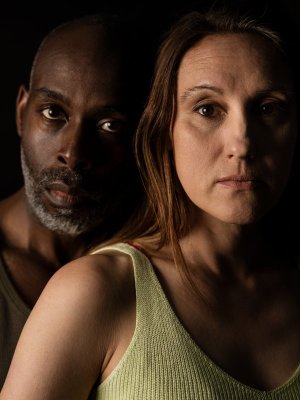 The mystery of the trauma is entwined with the origin of the box itself. Kate’s frustration with wanting to ‘get inside it’ can be interpreted as a metaphor – her quest for answers, for ‘the truth’, whatever that is…
I don’t often mention what the cast wear onstage, but in the case of this play, the cast’s mutual wearing of black and red at times (in reversal of each other) makes for a powerful combination. While there is a ying/yang energy to this, one can see that at a subliminal level, the colours reflects the polarised energy of the couple who are pulling in different directions every which way – in terms of their way thinking, emotions, their approach to guilt…
As Tom, Edwards conveys a man who is trying to keep everything together and not ‘fly off the handle’. While it is evident he has strong feelings on certain subjects, for the most part he keeps them in check. In contrast, Lawrie’s Kate is heartache personified – feeling a myriad of emotions and thoughts, but for one reason or another can’t bring herself to unequivocally say what she means. Both parties have ‘itches that can’t be scratched’. Perhaps with the box-shaped object at home, there is an ‘out’ for both of them…
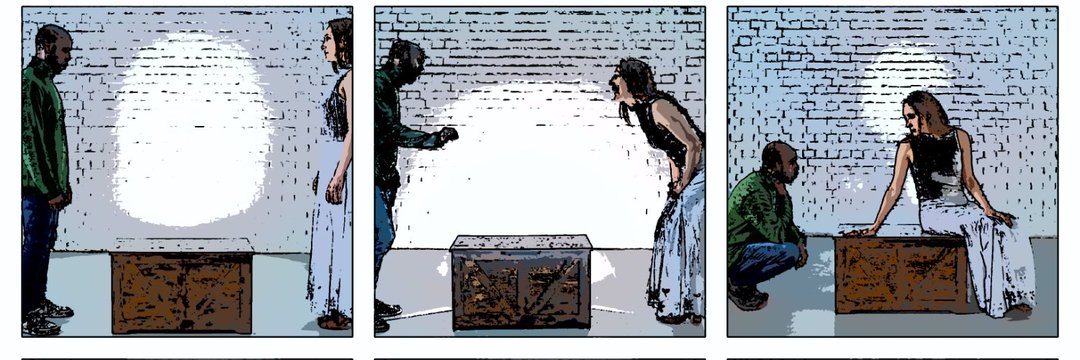
So what lessons can one draw from this play? Truth is paradoxical. It can be liberating, set you free. It can also induce guilt with a vice-like grip. One can justify lies for any number of reasons, but don’t lie to yourself. That is the surest way to lose one’s ‘true north’ – to ‘lose your way’, to not tell ‘which way is up’…
© Michael Davis 2024

The Box runs at the White Bear Theatre until 3rd August.
 Breaking The Fourth Wall