I like a good, meaty drama. And if it’s centred on a family, it’s ‘all gravy’…. Written by Sarah Majland (who plays one of the main characters), Quid Pro Quo Theatre’s The House We Inherit deals with family secrets and the subsequent absence of closure. But beyond the explosive scenes, the play is really about the ‘journey’ – how actions and conversations (regardless of how small or ‘trivial’) all contribute to ‘the point of no return’…

The play focuses on three siblings of an American family who all hail from a small town. Following the deaths of their parents a few years previously, the family home has passed down to Timmy Wright (Boyan Petrov) the middle sibling. His older sister Helena (Sarah Majland) lives in New York and hasn’t been back ‘home’ since leaving for college. Unfortunately for Timmy, along with the house, he’s also ‘inherited’ a heart defect and has only a short time left to live. Acting as his ‘carer’ is his younger, adopted brother Kevin (Öncel Camcı) who has also recently moved back to the family home. But following an ‘accident’ involving Timmy, Helena is notified as ‘next of kin’ and travels back to the homestead to see her brother. Suffice to say, her presence is unexpected and immediately felt…
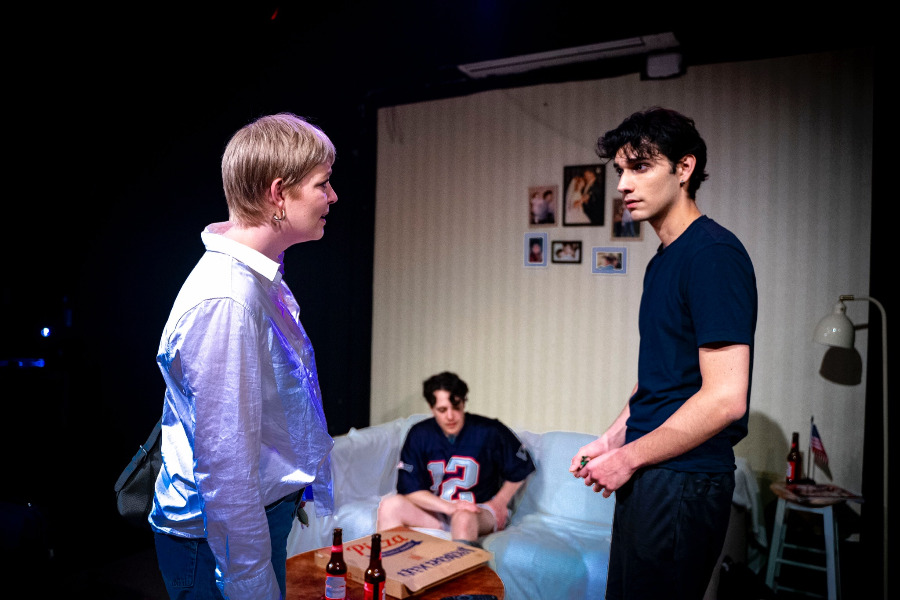
In any family drama, there are certain themes and threads that inevitability crop up. The way they are executed, however, is a different matter. Conversely, there are certain things in a family drama that you want addressed in the interests of realism and versimilitude. The House We Inherit has all this and more.
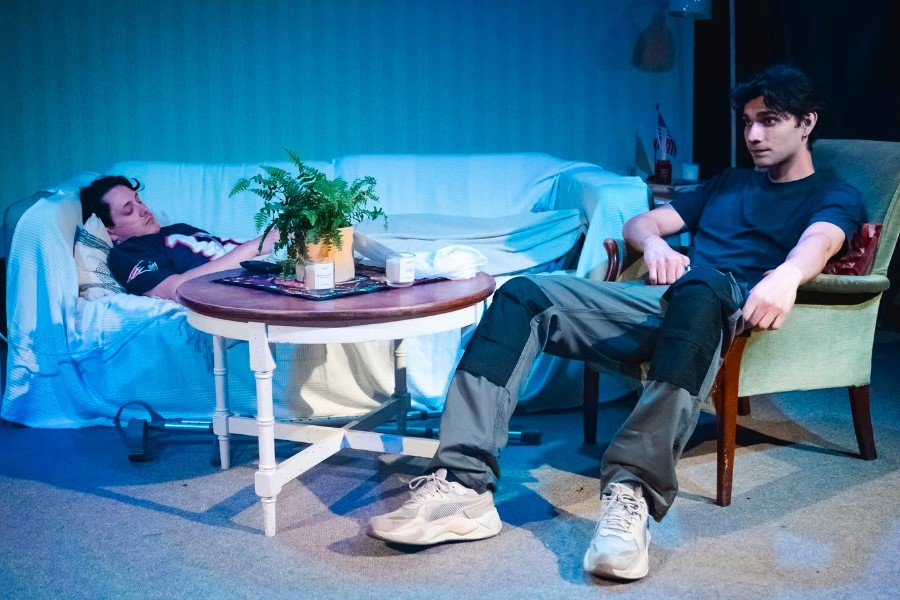
Invariably, at least one person is perceived to be ‘successful’ or ‘together’, which in this play is Helena. However, beyond the ‘facade’, all might not be rosy for her on the domestic front. As for those whose lives are ‘a work-in-progress’, this could be attributed to both Timmy and Kevin. But as Timmy has a few weeks left to live, long-term plans are moot. As for Kevin, the adopted sibling, the ‘malleable’ nature of his ‘status’ in the play is a major plot point and in the ‘Venn’ diagram of relationships, he is paradoxically right at the centre of events, as well as an observer ‘from the outside’.
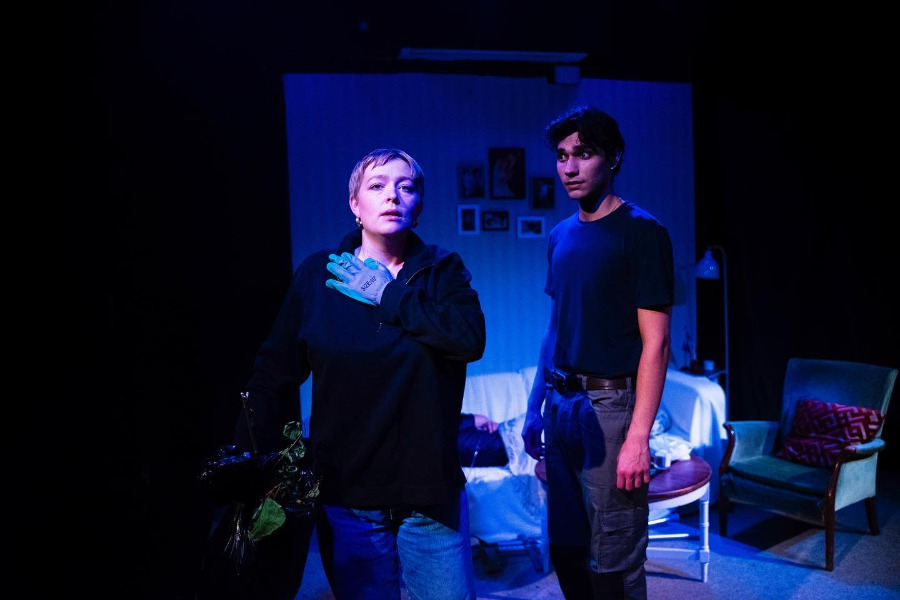
While an interest from the siblings in each other’s love lives is to be expected, their perspective and the consequences of their support in the play – while perhaps underplayed – is of pivotal importance and shows how family can make a difference in clarity and perspective. The play also highlights how depending on the topic, two of the three siblings may ‘gang up’ (‘jokingly’) on the other, though this also goes to show that ‘sides’ in any situation can’t be taken for granted.

All three actors are to be commended for their performances and while their individual moments of quietness and silence aren’t Pinteresque, the adage ‘less is more’ is very applicable in the moments of tension. If one person, however, had to be singled out, it would be Majland’s Helena, whose own emotional journey – while exhibiting two conflicting impulses – is remarkable and bears the hallmark of truth.

While the ultimate revelations can be be guessed if you are paying attention, the way they are played out are better than one can imagine. Quid Quo Pro’s previous productions have garnered much praise, but having not seen them myself, I was unprepared for the maturity of the storytelling and performances in this play… If there is any justice, The House We Inherit will at the very least be nominated for the next Offies Awards.
© Michael Davis 2024

The House We Inherit runs at the Bridge House Theatre until 1st June.
 Breaking The Fourth Wall