In Scandinavian and Russian folklore, the ‘hour of the wolf’ occurs between 3 and 4am – the time when people are most prone to being kept awake at night by crippling worries, as well as the time when deaths and birth take place in equal measure. It is somewhat fitting then that in Rosamund Gravelle’s play Three Queens, all three of the main characters wrestle with their fear and doubts around this time, using conversations with each other as a whetstone to sharpen their respective resolve.
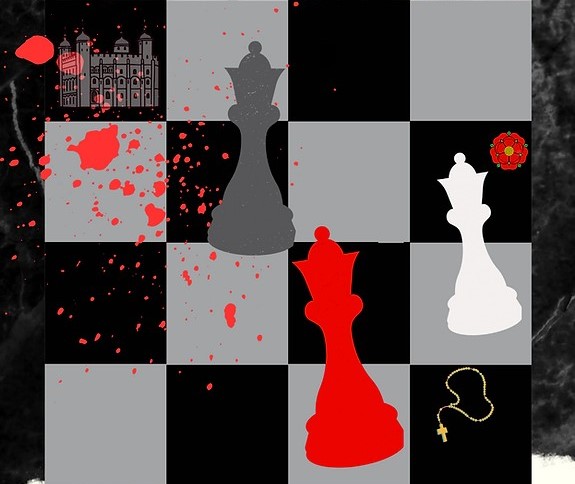
Directed by Sharon Willems, Three Queens takes place the night before Lady Jane Grey – a queen for only nine days – is sentenced to death. As the reigning Catholic monarch who is also engaged to the Catholic king of Spain, Queen Mary (Becky Black) doesn’t have unilateral support from the royal court or aristocracy. Edward VI – the only surviving son of Henry VIII – wanted to protect the Church of England which his father helped instigate. But who could he entrust to safeguard his father’s legacy? While Mary is a staunch Catholic, Elizabeth (Eliza Shea) is an unknown quantity. That just leaves Lady Jane Grey (Martha Crow) who despite her young age and being the exact opposite of Mary, holds convictions just as deeply held and intense.
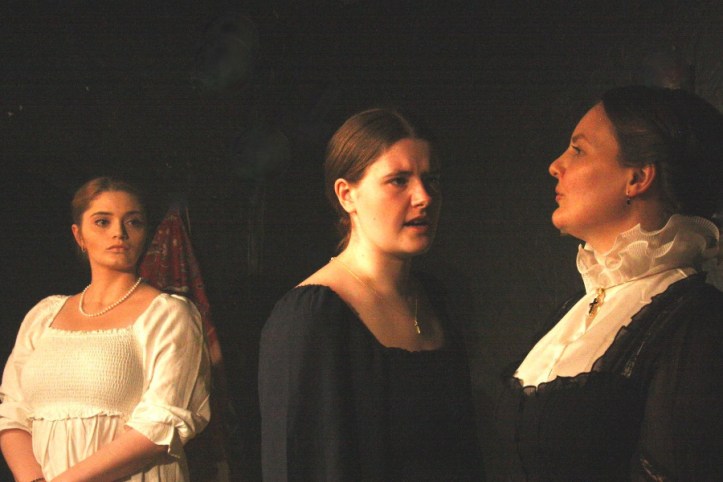
Acting as a mediator between all is Cardinal Pole (Les Kenny Green) who wants Mary to give Jane a chance to recant her religious beliefs to avoid her execution. One of the surprising things about Three Queens is how it subverts the usual depiction of well-known historical figures. Known as ‘Bloody Mary’ for the persecution and deaths of Protestants during her reign, here we see that Mary believes implicity in the rightness of her course of action ‘for the greater good’ and not begat by ‘bloodlust’.
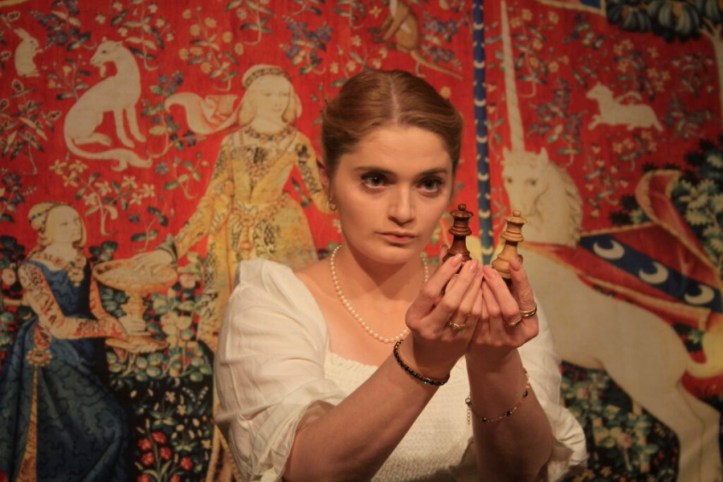
As for Elizabeth, who we know later will become Elizabeth I, here she is ‘apolitical/agnostic’ in the sense that her first priority is survival, rather than making a public statement about her innermost convictions. In many ways she is the ‘shrewdest’ of the three and most adept at ‘statecraft’ – keeping her ‘cards’ close to her chest.
Then there’s Jane. Far from being an ‘easily swayed’ teenager, the power of her conviction makes her resolute, arguably even arrogant. One could also argue that there are overtures to Joan of Arc with her character, where for her personally, the biggest ‘betrayal’ would be to deny the ‘justness’ of the rebellion she spearheaded. There are also moments with her character that one senses there is a real ‘hunger’ for power to do away with the ‘enemies of England’ and the acquisition of the crown as a goal in its own right.

In any case all three women – at one point or other – question the total legitimacy of their way of thinking and wish the hard decisions are taken away from them. In this respect, the ‘soul searching’ night is their personal ‘Gethsemane’.
From a technical perspective, the use of candlelight to illuminate the proceeding evokes similar atmospheric productions that take place at the Sam Wanamaker Playhouse. The tapestry and ‘stained-glass’ lighting are effective too.
© Michael Davis 2024

Three Queens runs at the Barons Court Theatre until 11th May.
 Breaking The Fourth Wall