Imagine if in the UK or US, a teacher went directly from a role in education to leading the country. With their intimate knowledge of where society fails those ‘who have been left behind’, they could rectify the many inequalities that exist. Of course many politicians would hate this, as well as the institutions that want to keep things as they are…
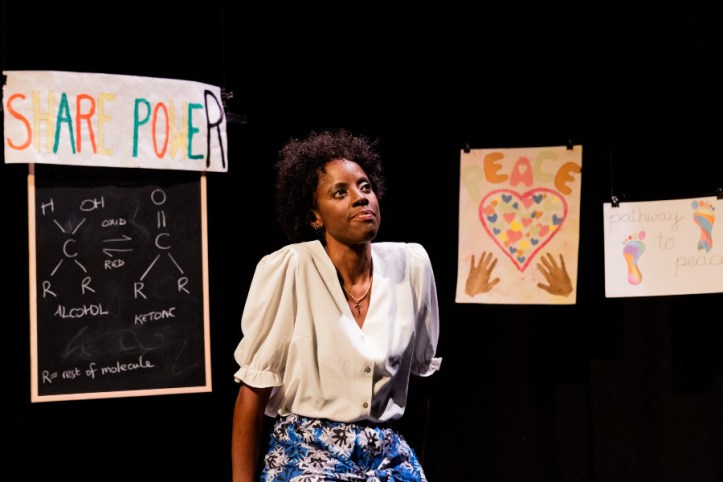
Written by Angela J Davis and directed by Mukal Ahmed, Agathe tells the relatively unknown story of Agathe Uwilingiyimana (Natasha Bain), a modern ‘Lady Jane Grey’ who was Rwanda’s head of state for less than a day before her assassination in 1994, at the start of the genocide against the Tutsi people in Rwanda. Right from the off, we see how Agathe uses her postion as an educator to be a champion of women’s rights and education for all. But news of Agathe’s egalitarian disposition isn’t welcomed by some, and for privileged people in any country, equality for all feels like oppression.

So let’s talk about the ‘elephant in the room’: why would a British audience want to watch a play about what took place in Africa 30 years ago? If we’re honest, the divisions between the Tutsi and the Hutus are meaningless to most people outside Africa. But if one were to imagine what issues may arise between the opinions of a rural and urban population, between those who feel they’ve been overlooked and those who don’t like the ‘direction’ the country is going, one can see the parallels in almost every country in the 21st century. What event would be the ‘final straw’, the catalyst for a civil war in your country?

Offering an ‘outsider’s’ point of view are UN peacekeepers Addie and Carrie (Jordon Kemp and Maria Austin, respectively). Through them, we get the opinions of the few westerners who may know a little about what Rwanda is facing, but are ultimately powerless to stop the ‘tsunami’ that’s coming. As a country without oil reserves or any other resources the developed world values, there isn’t the push from the West to intervene or save those most likely to face death…
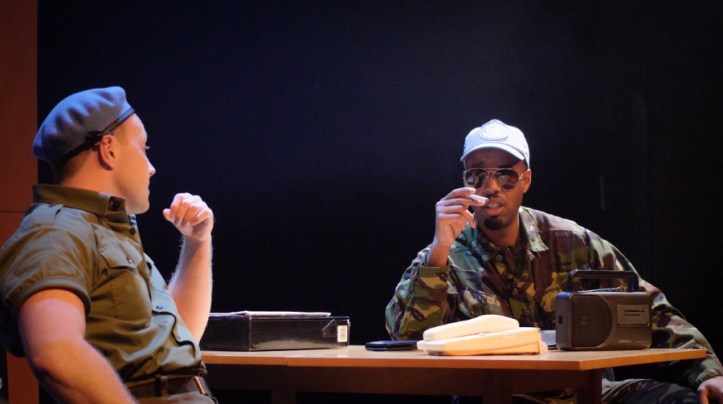
Both the peacekeepers are ‘taken under the wings’ of more experienced individuals. In Addie’s case, he has Captain Mbaye Diagne (Rio Attoh-Wood) who is much more worldly-wise and originally from Senegal. In Carrie’s case, it is Agathe herself who ‘takes care of’ her, who becomes in some ways a surrogate mother to the peacekeeper.

Interspersed between the main scenes, Matthew Faucher as the Radio Announcer (who also plays Agathe’s soon Lucas) gives a flavour of what the rhetoric was like at the time, a countdown towards the country’s imminent implosion.

As you might expect, Bain’s performance of Agathe anchors the world of play, conveying a woman who defies stereotyping – religious and principled, yet liberal in her outlook and wanting the best for all. Likewise Austin, Kemp, Attoh-Wood and Faucher play their respective roles admirably – expanding the wider circle the audience empathises with and conversely, ahead of Agathe in piecing together ‘the bigger picture’…

While the play is at one level about one woman’s story at the height of the troubles in Rwanda, similar events lies ahead for every country that doesn’t find a way for dialogue and cooperation between all to take place. Also, the fact that the present British government has been pushing legislation to deport people to Rwanda – knowing what happened there a few short years ago – beggars belief, indicating its own lurch towards the extremist actions and a warning to us all.
Do yourself a favour and catch this play before the end of the weekend. You’ll thank me later.
© Michael Davis 2024

Agathe ran at Stanley Arts on 30th April and 1st May. It continues its run at Playground Theatre until 4th May.
 Breaking The Fourth Wall