For every Picasso, Monet, Francis Bacon and Andy Warhol who achieved fame and success during their lifetimes, there are so many with artistic pursuits who haven’t had their “15 minutes of fame”. For those pursuing disinction as a ‘serious’ artists (as opposed to ‘Sunday painters’…), they require more than just raw talent to achieve their end goal. They need someone to believe in their talent and champion them within the ‘right circles’. Thank goodness then that Cyril Mann had Renske van Slooten…
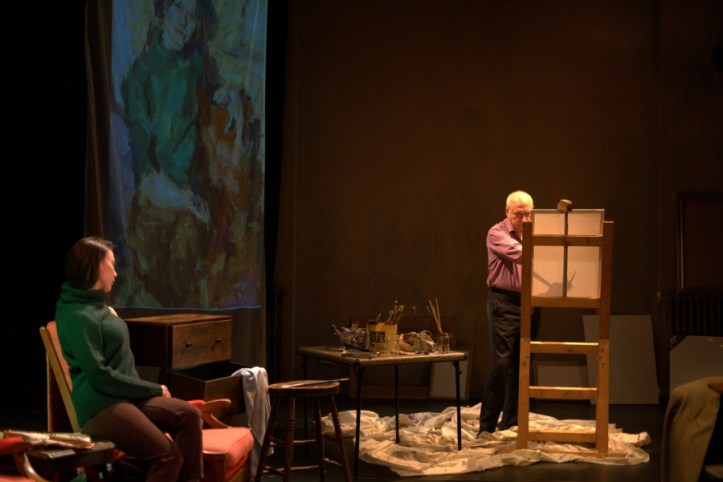
Adapted by Gail Laow from Renske van Slooten’s memoir and directed by Christian Holder, the world premiere of The Girl in the Green Jumper takes place at the Playground Theatre. It is December 1959, and 19-year-old Renske (Natalie Ava Nasr) drops in at the end of Cyril Mann’s (Peter Tate) art class. As a young woman of Dutch/Indonesian descent, Renske and her family moved to the Netherlands in 1950, when the Dutch East Indies gained independence and became Indonesia. Perhaps not finding anywhere where she truly belonged or her place in the world, Renske moved to London in 1959, where she met Mann, a working class painter 23 years her senior. Convinced of his talent, Renske would eventually become his muse, model and financially support him so that he could paint full time. And while Mann may have had the wherewithal to think meeting Renske was fortuitous, he had no idea how much she would change his life – ‘professionally’ and personally – the best thing that ever happened to him.
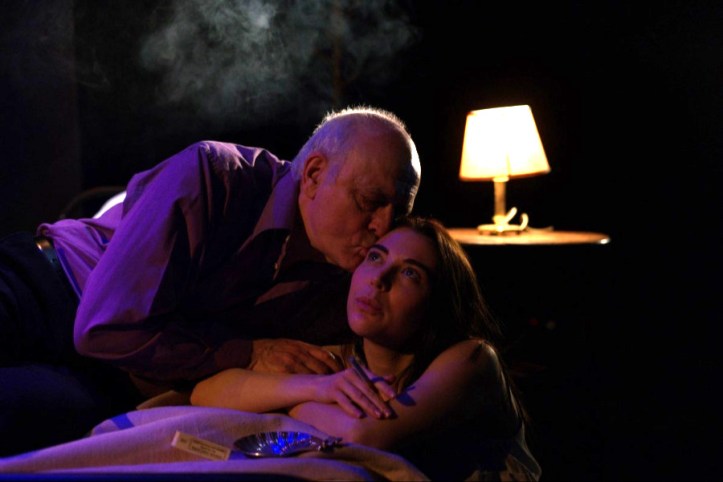
Tate as an actor is no stranger to playing 20th century painters. As Picasso, Tate has performed in the eponymously-named play by Terry d’Alfonso and in Picasso: Le Monstre Sacré. As Cyril Mann though, Tate is equally convincing as the ‘anti-Picasso’ – someone who was not a ladies’ man or had compelling charisma, nor recognition from the wider art world. Mann thought about everything in the context of money, the one commodity he didn’t have as a working class painter. It dictated the size of his canvases, the amount of paint he could buy and the ‘modest’ (think one room) flat that he lived in.
In the literary arena, Mann’s mental health would find parallels with Eeyore in AA Milne’s Winnie-the-Pooh books and Douglas Adams’s Marvin the Android. It would take someone with an insurmountable reserve of optimism to assauge Mann’s natural predisposition for sceptism, borne of a lifetime’s worth of disappointment… The only things Mann and Picasso perhaps had in common were ‘old-fashioned’ views of the relationships between men and women, and a brusque ‘take it for granted’ view of the ladies in their lives. But if Mann was the underbelly of the first half of the 20th century, Renske very much represented the zeitgeist of the latter half, using her ‘soft skills’ in liasing with people to introduce Mann’s work to the ‘right people’ so that he would achieve a modicum of recognition and financial success, and would eventually lead to her own career in PR in the wider world.

As Renske, Nasr initially gives off a naïve quality – not just because of the character’s age, but also the absence of apprehension in their unorthodox ‘relationship’ and age gap. One cannot imagine a British woman in the late ’50s/early ’60s willingly putting up with the arrangement that Mann had with Renske or their Spartan ‘lifestyle’. Yet Renske (for a time at least) accepts Mann’s lodgings and ‘demanding’ nature because she believes with her help, Mann will one day have his ‘day in the sun’. That is, until in a moment of epiphany, Mann deprives Renske of her sleep, like a selfish, petulant child. Speaking of which, the psychological demons that plague Mann from growing up in poverty and receiving corporal punishment also prove to be a sticking point for the relatively well-adjusted Renske, who has no frame of reference for Mann’s ‘predilections’. In any case, the palette and hues of Nasr’s performance expands over the course of the play, matching Renske’s growth as a person – eventually willing without guilt to state what she wants for herself and what she won’t…
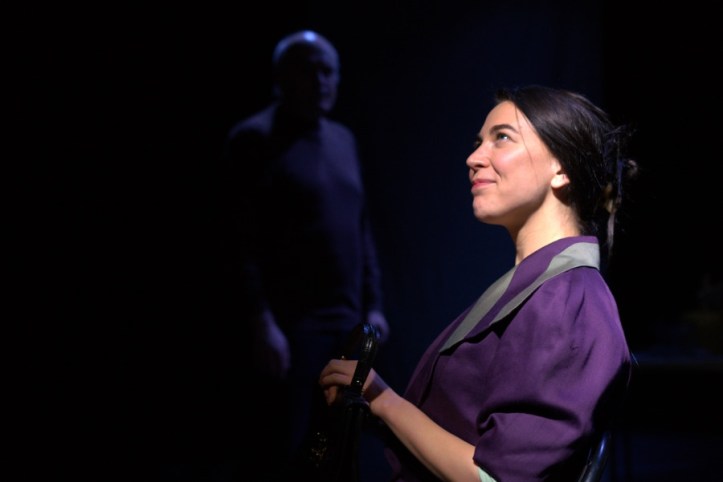
At some level, one can’t help watching The Girl in the Green Jumper without comparing the attitudes depicted with what is (or isn’t) accepted today and contrasting them. Even so, aspects of both characters resonate with audiences in the 21st century, whether it is Mann’s frustration with the Arts being the purview of the affluent or Renske finding her place in the world, without necessarily having the full support of parents or people she knows.
© Michael Davis 2024

The Girl in the Green Jumper runs at the Playground Theatre until 24th March.
https://www.theplaygroundtheatre.org.uk/projects/the-girl-in-the-green-jumper
 Breaking The Fourth Wall