Theatre can be about anything, as it should be. But some topics every year without fail. Gambling addiction, on the other hand, is rarely addressed and the last time I wrote about this topic was back in 2017 for a show in Edinburgh: https://breaking-the-fourth-wall.com/2017/08/11/fix-edinburgh-fringe-festival-review/ Seven years later, with the advent of online gaming now on phones, the topic is more relevant than ever…

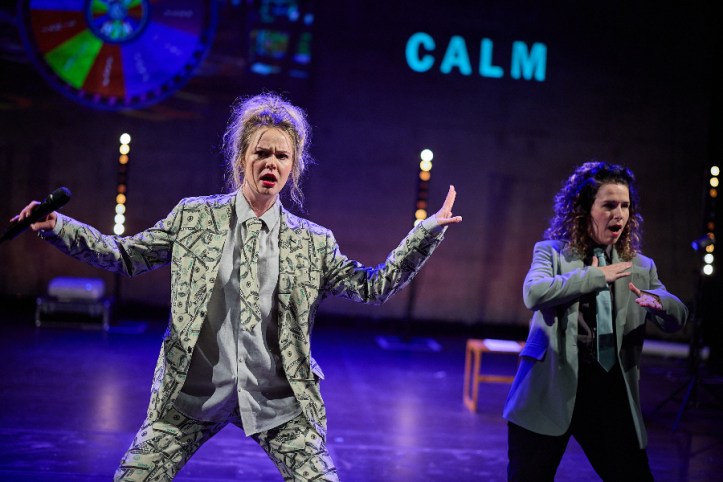
Conceived by theatre-makers Hannah Walker and Rosa Postlewaithe, Gamble examines the proflieration of the gambling industry in the UK. When broaching this particular subject, there is always the possibility of being didactic, of not letting the audience come to their own conclusions. With this in mind, the early part of the show has Walker front and centre in a ‘dollar bill suit’ (much like a game show host) and accompanied by BSL interpreter Faye Alvi. It has to be said that rather than feel like an appendage, Alvi’s presence and intergration with Walker’s are complementary and indivisible – arguably the best use of BSL in any show to date.

Mimicing the bright lights and sound effects that accompany online gaming, there are segments that make use of the graphics of gamimg machines that lure punters and coax them to play indefinitely. There are also occasional songs that maintain a level of levity within the early part of the show. In addition, there’s also a narrative about a girl from a village and a ‘hairy man’ and what happens over the course of their relationship. But more of that later…

As I write this review, I’m sitting in a pub, quite close to some quiz/gaming machines. Machines such of these have long been a staple in drinking establishments, but therein lies the insidious reach of the gambling industry, making the pastime of winning (or rather losing) money seem as ‘natural’ as drinking on a night out. Most of the people playing the machines are ‘older’, drawn to them shortly after arrival, like moths around light bulbs. The machines all display the ‘gamble responsibly’ notice (‘Be in control. Set your limit. Blah Blah Blah. BeGambleAware.com’) that puts the onus on individuals, rather than the industry itself. The machines also list where online that other ‘games’ can be played (which is where the ‘real’ money is). These are all points that referenced in the show, but once you’re outside in the ‘real world’, you realise how gaming is ‘hiding’ in plain sight and the observations made in this show are so true.
But I digress.

The part of the show that is arguably the most compelling are the personal experiences of people recovering from gambling addictions. We also hear from Walker herself who we find out was inspired to create the show following finding out about her partner’s ‘relationship’ with online gambling (who are both the real ‘girl and hairy man’). Knowing the stigma within financial circles and the wider world about debt and gambling problems, Walker’s decision to investigate the world of gambling was to not only highlight the problem at large, but to also get to grips with the situation her partner found himself in. The anecdote about the Gamblers Anonymous meetings shows how liberating speaking about the problem can be for the ‘addicts’. However, for those who are indirectly affected, the ‘regurgitation’ of the past and the reminders of debts still owed can provide cold comfort. In addition, the sensitive issue of whether to stay with partners who are in the throes of addiction are also addressed.
The second half of the evening is dedicated to a discussion between Walker, the audience and Dr Matt Gaskell who works for the NHS, counselling those with gambling addictions. In some ways this, along with previous anecdotes, is the ‘meaty’ part of the evening, with lots of facts and anecdotes that people aren’t privy to – and some quite surprising. Around 30% of female gambling addicts are female and if I remember correctly, there is a similar percentage of deaf gambling addicts. Cut off from the rest of society, it’s a problem they often endure completely on their own. The show is likely to evolve over time and I’m sure Dr Gaskell’s invaluable insights and presence will be assimilated more readily in the first half of the show.
In any case, Walker, Postlethwaite, Alvi and rest of the creative team should be commended for not only trying to raise awareness on this little known issue, but for the ‘pastoral care’ following each performance (see below*), which only goes to show this is a project they are truly passionate about and not a gimmick.
© Michael Davis 2024

Gamble concludes its UK tour at the following venues and dates:
Mercury Theatre, Colchester 22nd March
Exeter Phoenix, Exeter 28th March
*The morning after each performance, coffee mornings are also arranged so that anyone directly or indirectly affected by the issues raised in the show can talk with others in a safe and supportive environment.
 Breaking The Fourth Wall