Theatre at its best is supposed to encourage people to think and feel deeply about characters and situations that resonate with the world today. Can’t See For Looking by Carloyn Lloyd Davies (with co-creator Franchezka Cunanan) is one such play. Trafficking, in one form or another, has been an ongoing activity for the past 40 years. What this play shows is that the boundaries between ‘indentured servitude’/modern slavery, sex workers and every other form of trafficking use the same networks – often overlapping, but ultimately taking away the freedom of all.

At the centre of this tale is Rosa (Margarita San Luis) a young Filipina woman who has claimed asylum in the UK and is interviewed by John (David Trevaskis*), an agent of the Home Office. He periodically confides in the audience, explaining his rationale for his thinking and actions. While later in the show, John’s actions become ‘less harder’ to justify, initially at least the arguments he raises regarding a nation having limited resources are ‘less objectionable’ in principle, if not in spirit. “Have you come here to escape poverty? There are many people in the UK trying to do the same…”
But I digress.
By his own admission, John indicates that empathy isn’t a personal quality favoured by those in his line of work, that there is no room for being ‘soft’. Like the rest of his colleagues, John assumes that everyone he interviews is lying to him. It’s just a matter of degree…
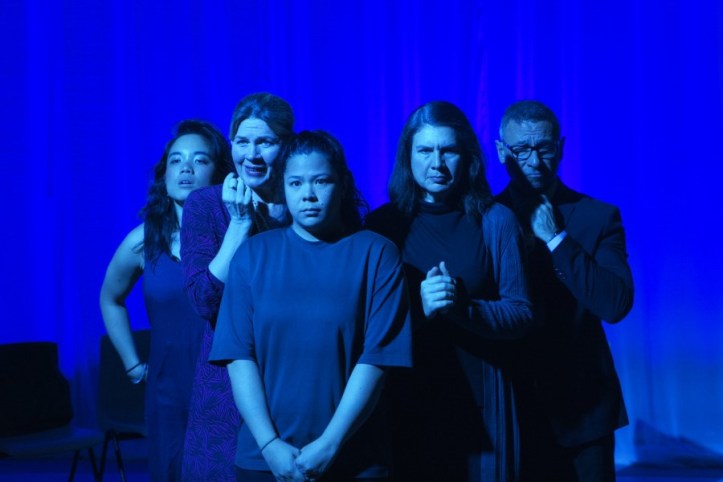
Rosa as a character is in some ways naive about bureaucracy and how the asylum system works. Given how she was roped into ‘being a nanny’ in the first place, it is perhaps not surprising how ‘green’ she is, even with all the awful things she’s endured in recent years. Her companion, Angel (Ericka Posadas) – who we later hear how she ‘saved’ Rosa – initially accompanies her for support, but is told to leave by John for her ‘emotional outburst’. Just like for most of her time ‘in service’, Rosa is alone and has no one to look out for her.

This brings us to the ‘hard’ questions… By Rosa’s account, her family lives on the ‘breadline’, and they struggle to pay the medical bills for her mother’s tuberculosis. Yet Rosa has an affluent ‘uncle’ (in reality her father’s cousin, but a red flag sign in hindsight) who suggests she work as a nanny for one of his wealthy business partners overseas. Working in a job that would pay towards her mother’s medical bills, plus the opportunity to travel seems like a ‘no brainer’ for Rosa. But as the saying goes, if anything seems too good to be true, it probably is and John’s line of inquiry picks apart the inconsistencies and unresolved questions, taking the audience down the ‘rabbit hole’ of the truth.
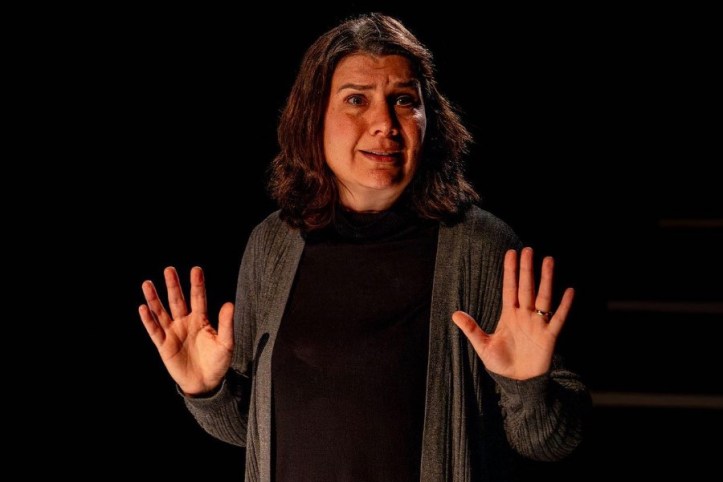
The family who ‘hired’ Rosa hail from the UAE, but as Rosa finds out, the real matriarch is Nura (Rania Kurdi) – the ‘grandmother’ who runs the household. Time and time again we hear how ‘servants’ should behave – as if Rosa’s naturally demure demeanour is rebellious or argumentative. During the ‘interview’, John keep on returning to Rosa’s ‘inability’ or ‘refusal’ to act, ignoring ‘inconvenient facts’ such as the removal of her passport and ‘policed’ visits to the shops preventing speaking to the general public. In many ways, John is just as guilty as Nuri of gaslighting Rosa and implying everything is her fault. Though it has to be said, he never physically beat and kicked Rosa, in private or public…

Case in point: Henrietta (Laura Fitzpatrick). As a well-heeled socialite who is privy to the affluent and arranging events for charitable causes, she notices from time to time the bruises on Rosa’s arms, and witnesses first-hand an ‘altercation’ involving Nura and Rosa. After doing the bare minimum to reach out to Rosa, Henerietta doesn’t report her suspicions to the police, before or after Rosa is free – worrying about ‘getting it wrong’ and her social status. “Surely people as rich and cultured as Rosa’s ‘employers’ can’t be guilty of..?” While it would be easy to criticise Henrietta’s actions, they do unfortunately mirror the real world where those with ‘connections’ and money are given the benefit of the doubt (and when convicted, leniency). Also, regarding human nature, we as a species prefer to stay in our comfort zone and ‘not know’. Because if we had overwhelming evidence, we really would have to ‘act’, which would be ‘inconvenient’…

The character of Angel and the network of former ‘slaves’ in the UK offers a glimmer of hope, though the fact that this underground movement ‘has’ to exist because of what’s happening ‘in plain sight’ should make us pause for thought. Angel’s final remarks to Henerietta are satisfying for the audience, being able to tell it like it is with censoring oneself is truly liberating. But people – especially if they know they are in the wrong – seldom accept the truth and take umbrage that they should bear any guilt.

It feels like it’s been a long time since I’ve watched a show that made me feel ‘angry’ about ‘the way things are’ and the absence of visible justice. However, this play is a reminder that theatre can have something to say about the here and now, and that just because it has a message, doesn’t mean it’s didactic or ‘preachy’. If anything, the power of Can’t See For Looking lies in the fact that it shows all sides of the argument of modern slavery, and if you want to apportion blame for how and why it thrives in the 21st century, governments the world over need to address their blind spot to where the money trail leads to.
That’s where the due diligence should lie.
© Michael Davis 2023

*On the evening I attended, the director David Trevaskis, took over from Fanos Xenofos, who was ill.
Can’t See For Looking runs at the Cockpit Theatre from 18th October to 4th November (7:30pm).
 Breaking The Fourth Wall