Most people with a passing knowledge of King James I of England (who was previously known as King James VI of Scotland) know of his interest in witchcraft and demonology, and that this spurred Shakespeare to write about Macbeth. But what was the catalyst for James’s own interest in witchcraft in the first place? Certainly, what was happening in Denmark (where his Danish fiancée hailed) could be blamed, but perhaps it was the allegations and hysteria sweeping Britain regarding the latest group of ‘undesirables’ and ‘scapegoats’ – those who followed the ‘old ways’…
Written by Gavin Fleming and directed by Lydia Sax, Sabbath: a Tragedy of Witches is an historical account of one such witch-hunt and arguably the reason for the exponential rise of persecuting women in Scotland for ‘dabbling in the esoteric’…

All Hallows’ Eve 1590: Agnes Sampson (Muireann Gallen) – midwife (and something of a reputation as a healer) celebrates the occasion with members of her community with singing, dancing and games. A short while later, Sampson finds herself in prison with teenager Gillis Duncan (Ellana Gilbert). What could have been a perplexing Kafkaesque experience is soon made clear by the revelation that not only are they accused of witchcraft, but of using the Dark Arts to conjure a storm to kill King James and his bride-to-be earlier in the year. If this all seems a bit ‘fantastical’, one only has to look at the parallels today with disparaging rumours in social media that gain traction with alarming speed.
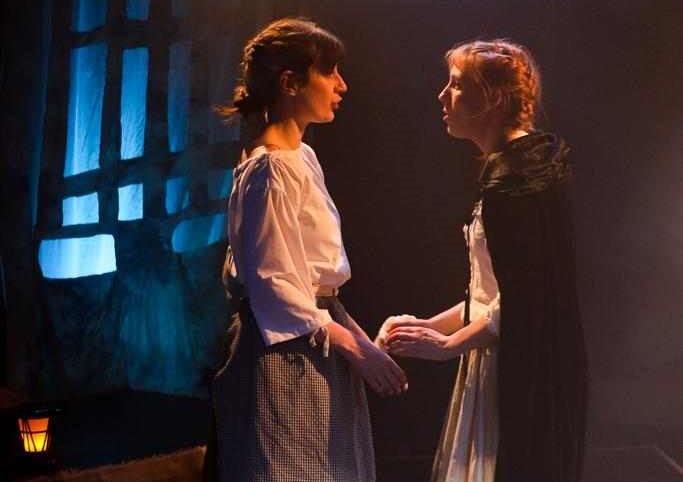
Agnes (‘Aggie’) as a character is in many ways a modern, ‘anachronistic’ woman who shows deference to ‘His Majesty’, but doesn’t suffer the patriarchal hegemony who have made it their mission to find damning evidence to convict her. In many ways her circumstances are like those of Joan of Arc, but unlike the ‘Maid of Orleans’, doesn’t exhibit the conventional ‘humility’ that women were expected to demonstrate to ‘their betters’.

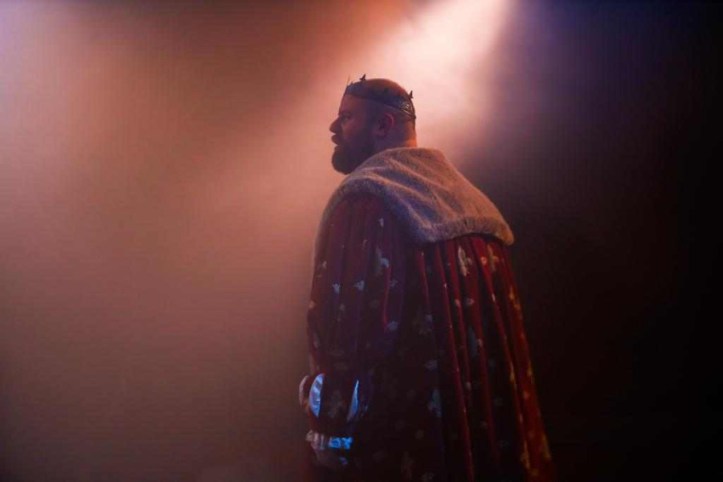
As King James, Derek Jeck bestows to the character a weariness of the trappings of State and certainly initially in the play, one wonders who is really the ‘prisoner’. James’s verbal advocation of ‘reason’ and the ‘search for knowledge’ on the surface suggests he is simpatico with Agnes and she thinks she can appeal to this ‘Renaissance’ man to sweep away the charges – or at the very least, find clemency. But that is a lot of ifs, and while regents such as Henry VIII made a name for himself with ‘pushing the envelope’ of what a Head of State was allowed to do, James – publically at least – abides by the sanctioned etiquette of ‘Christendom’s monarchs’.
Barring Jeck, all the other male characters are played by women, doing an admirable job of conveying the darker (or less sympathetic traits) of the men of authority in this tale and their mixed motives. At times they reminded me of the cast of It’s True, It’s True, It’s True – another play with an all-female cast, about Artemisia Gentileschi who was ‘accused’, but judged by the men using underhanded ways to discredit her.
But I digress.

Also worthy of note in Sabbath are the performances of Niamh Drumgoole who played Seon, Gillis’s guardian, Nicole Cuthbert as Bowes, the English ambassador who struggles to maintain ‘neutrality’ and Kat Stidston as Barbara, a woman whose yearning to be a mother leads to ‘seeking help’…
If the first half of the play deals with the womens’ initial incarceration and their treatment by men involved with their trial, the second half ‘muddies the waters’ as it becomes apparent that there is not one singular truth but layers – which when interpreted by an absolutist criteria, makes Agnes ‘guilty’. In today’s world, nuance is an increasingly rare commodity, but hundreds of years before the so-called Age of Enlightenment, its absence led to unilateral damnation…
© Michael Davis 2023

Sabbath: a Tragedy of Witches runs at OSO Arts Centre from 31st October to 5th November.
 Breaking The Fourth Wall