Back in November 2014, Clare McIntryre’s Low Level Panic – a female-centric play set in a bathroom – ran at the Etcetera Theatre, London. Nine years later, Alice Motta makes her own debut at the venue with Sacred Bath. Much like McIntryre’s drama, Sacred Bath is a multilayered play that deals with women’s perception of their own bodies and their objectification by men. However, unlike Low Level Panic, Motta’s play is autobiographical – and candidly so.
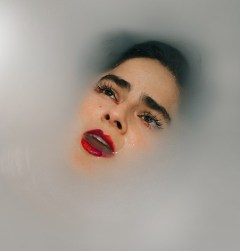
As a Brazilian actress based in London, Motta switches back and forth between English and Portuguese in the show at different intervals. For the (solely) English-speaking audience, they’re able to understand the gist of what’s going on anyway – partially because the switch between languages takes place at clearly marked junctures and partially because the physical actions that take place when Portuguese is spoken communicates the essence of what’s taking place.
There is evidence throughout the show of Motta’s ‘spiritual leanings’ (or at least how its ‘vocabulary’ has shaped the way she expresses ideas). Yet it’s also apparent that the ‘comfort’ she gets from her beliefs is tempered by life, her friends in the LGBTQ community, and her own sexual experiences. But while there are occasions in the show when Motta sings hymns in English in a calm, contemplative manner, her inner ‘fire’ – her vitality and love for life – is expressed (subtly) by the light of her candle, as well as overtly by dancing and the singing of upbeat songs in Portuguese.
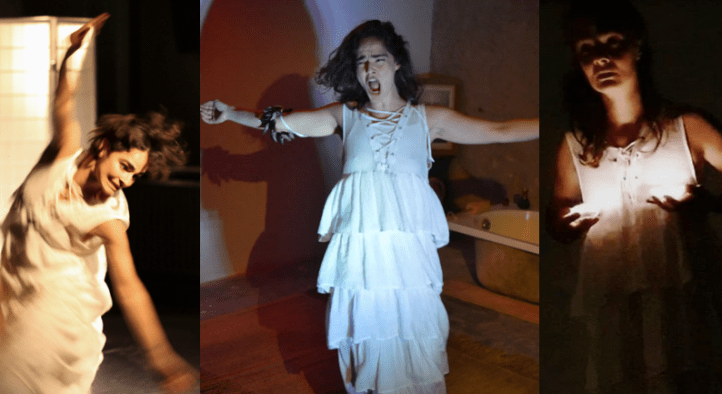
The show puts forward the oft-quoted notion of the body being a ‘temple’. But what does that mean exactly? To treat it with reverence, as something ‘sacred’? To visit it and spend time there? To ‘use’ it?
The scenes that revolve around casting calls and the behaviour of men on the set mirror the reported experiences of many women to date. Torn between not ‘wanting to make a scene’, yet desperately wanting the chance to act in a production of note, some men take advantage of this and what they can get away with.
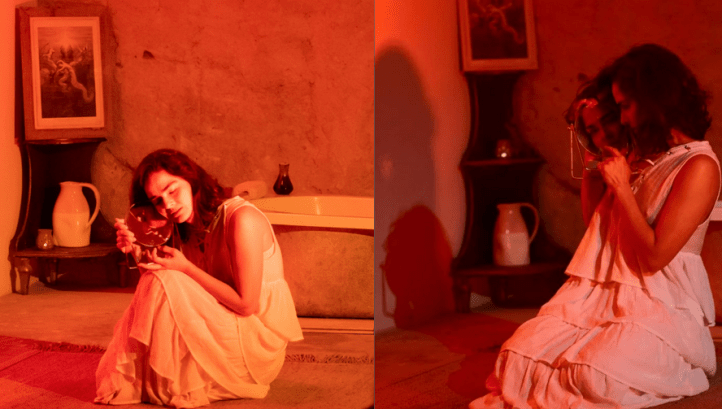
However, through Motta’s experiences, we hear how the misogynistic treatment of females doesn’t just extend to adult women. Her recollection of one particular event from when she was seven-years-old is alarming – not only because of what one boy her age was doing, but because of the way her teacher ‘excused’ the boy’s behaviour as ‘boys will be boys’. If deplorable behaviour is ‘accepted’ and not challenged by women in authority, it’s small wonder that it is perpetuated by subsequent generations. Motta’s experience reminded me of the darker aspects of Maud Madlyn’s Webcamming Chronicles show and the violence towards Latin American women, simply because of their sex.
But I digress.
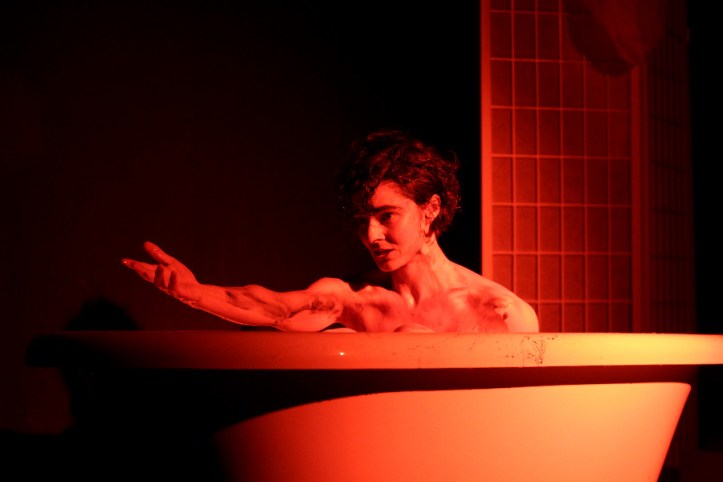
It is, however, at the nadir of Motta’s life, when things are at their bleakest that the significance of the ‘sacred bath’ truly takes root. While the ‘obvious’ allusions to purification and ‘washing away the past’ are present, it’s also for Motta a ‘Gethsemane’ moment – looking at her doubts and fears head on, and asking “Why me?”. Bathrooms are traditionally the one place where we can scrutinise ourselves honestly and physically see all our blemishes without artifice. But as Motta does some ‘soul searching’ during that time, she has a choice – to stay as she is and be subsumed by degredation at the hands of others, or to ‘wash’ it away and refuse to let it define her.
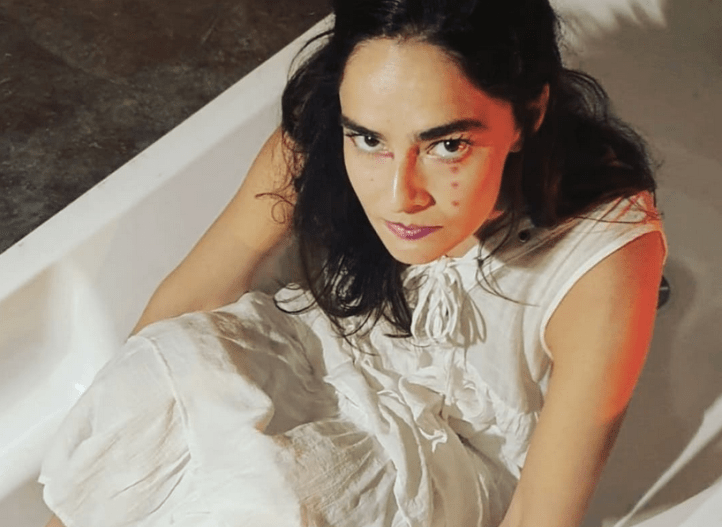
It could be argued that Sacred Bath is inspired by Frida Khalo in its use of ‘magical realism’ to convey heightened emoitional states and personal symbols that reflect Motta’s beliefs. While a very personal production, Motta’s experiences are representative of women the world over and regardless of the intentions of others, wrestle with keeping their innermost, ‘sacred’ self from being sullied.
© Michael Davis 2023

Sacred Bath ran at Etcetera Theatre, London on 18th, 20th and 21st September.
 Breaking The Fourth Wall