Western literature – whether we mean novels, poems or plays – has often been influenced by phrases or stories in the Bible. Ever since John Milton’s Paradise Lost, writers have taken inspiration from using well-known passages of scripture to hold up a true mirror to human nature, rather than the ‘lessons’ traditionally attributed to them. In recent years, Tristan Bernays wrote a serious of monologues for Testament on this subject, but he was standing on the shoulders of Bernard Shaw, Lord Byron, Oscar Wilde and John Steinbeck etc, in terms of pioneering this literary subgenre. Case in point: Birthright.

Written by TC Murray 90 years ago and directed Scott Hurran, Birthright takes its cue from the Old Testament story of Jacob and Esau. Similar to the dynamic with Cain and Abel, both the Biblical tale of Jacob and Esau and Murray’s version deals with the acrimonious fate of two brothers, with ‘parental’ approval (or lack of) stirring up the deepest feelings.

Set shortly before the First World War, we meet the Morrissey family at the cusp of great changes. Their farm, which is primarily run by Bat (Pádraig Lynch) and his younger son Shane (Peter Broderick), is going through hard times, and requires back-breaking work for them to earn the little that they do. Tradition (during that period in Ireland at least) dictates that the eldest son Hugh (Thomas Fitzgerald) inherits the farm, while Shane be sent to the New World to make his fortune (just as his father did). However, Hugh shows little knack or interest in the more gruelling aspects of farming life and ‘logically’, there is no reason why he should be the ‘heir apparent’. Things come to a head though, when celebrations for one of Hugh’s ‘non-farming’ accomplishments indirectly has disastrous consequences for the Morrisseys, pushing already-strained relationships to breaking point…
As in all good dramas, we’re able to appreciate the points of view of all the characters, and why the lack of communication and knowledge of the ‘bigger picture’ leads to the ‘perfect storm’ of discord.

Bat is undoubtedly a grafter, having spent 30 years building the farm and surrounding land from ‘nothing’. However, it has to be said, that life for him is just as hard as when he was a young man, with justifiable anger and frustration at his predicament. Bat also exhibits an aversion to all the (non-farming) pastimes that Hugh likes to take part in – especially playing sports and drinking. Bat’s disdain even extends to the local priest – an unusual sentiment to publicly voice in rural Ireland at that time, for encouraging Hugh’s ‘wayward’ ways (anything that takes Hugh’s attention away from farming). For Bat, working isn’t a means to an end to enjoy the nice things in life. It is EVERYTHING – a 24/7 pursuit for survival. Of course, anyone who doesn’t act in the same way as Bat is bound to sooner or later incur his wrath…
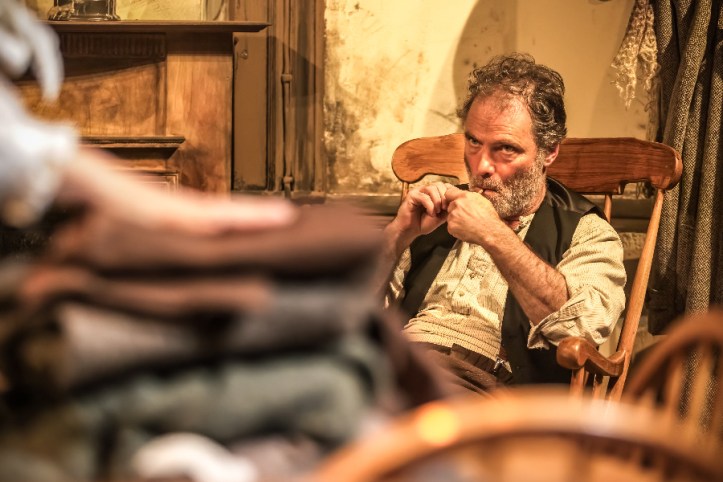
While Shane exhibits a natural affinity with farming (and on a meritocratic basis should inherit the farm), what makes his story compelling is the ‘unfair’ treatment that he’s endured in silence for many years. At the opening of the play, despite his industrious nature, there are plans to send him away. The Biblical Jacob was the ‘usurper’, who through cunning (and assistance from his mother) ‘cheats’ his brother out of his birthright. In contrast, Murray subverts this intention in his version by giving it a moral imperative – only the continued presence of Shane is likely to save the farm. Also, to use another Biblical allusion, Shane is the ‘good’ brother of the ‘Prodigal Son’ – only he’ll be damned if he’ll welcome Hugh with open arms…

It would be easy to paint Hugh in a negative light, but in many ways he (and the play itself) is all about hamartia, a term in Greek tragedy denoting a random accident or mistake, that leads to a chain of events with devastating consequences.
It be argued that there isn’t anything wrong with Hugh wanting more than the stoical existence that Bat and Shane have accepted as part of their lot. But indirectly, Maura’s treatment of the brothers has also sowed the seeds of discontent for the future. Supposedly not ‘physically robust’ as a child, Hugh was given ‘dispensation’ by his mother to not also partake in the arduous, physical work that his brother had to endure and given ‘less coarse’ clothes to wear (because his ‘sensitive’ nature). But Hugh’s ‘constitution’ doesn’t stop him fron his playing sports as an adult and even then, the lion’s share of grafting on the farm falls on Shane and Bat.
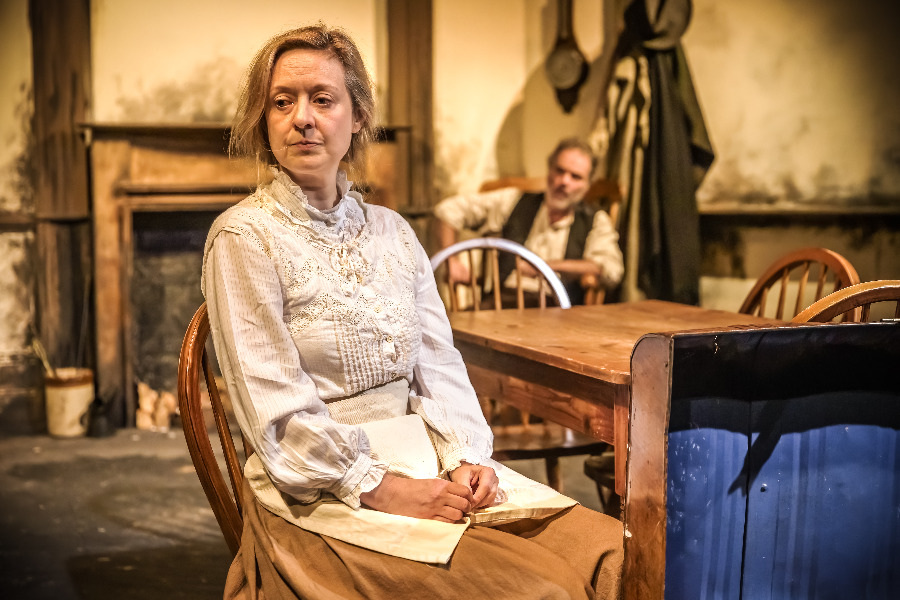
With our ‘hindsight,’ it would also be easy to cast some measure of blame on Maura for the way Hugh has turned out and his ‘preferential’ treatment, but that would be looking at events in absolutist terms. It’s plain to see in the play that Bat and herself are fire and water – his volatile personality (that almost always gets its own way) versus her passive, calming nature. Perhaps she saw something of herself in the young Hugh and vicariously lives through his achivements outside in the wider world. In any case, her ‘flaw’ (if you want to call it that) is that despite her good intentions, she didn’t spot the consequences of the respective treatment of her sons. Perhaps she only had enough influence with Bat to allow one of their sons to enjoy the activities in life that most people do. In any case, if Hugh had expressed absolute zero interest in the farm and left, the play would have veered down a different path. But the invocation of tradition as Hugh’s ‘right’ to the land doesn’t sit well with Shane, and much of what Bat and Shane have endured to date has completely passed Hugh by.
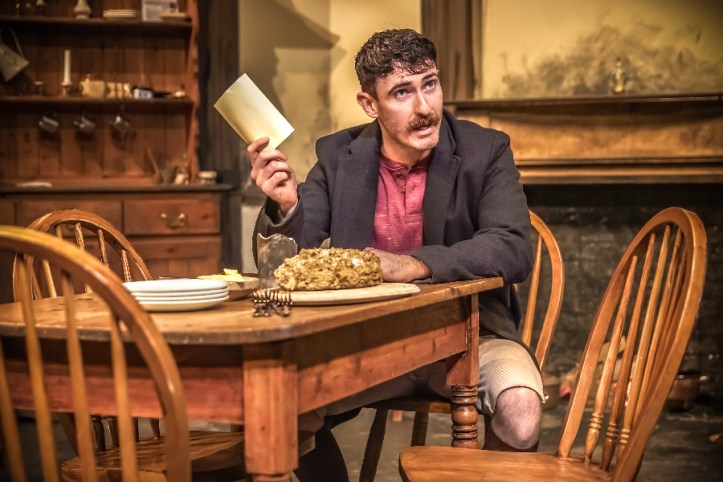
While Birthright is indeed an intense family drama, it could also be said to be about any country or society where there is deep-seated division derived from years of inequitable existence between two or more factions. In the case of Hugh, his ignorance of his brother’s feelings and personal hardships was always bound to engender strife down the line. The only question is, is Hugh ‘man’ enough to listen to others’ points of view, or will his sense of entitlement make him impervious to reconcilation? Time will tell…
*On separate note, set and costume designer Raphaella Wilcox should be commended for her contribution to the show. The audience feels completely immersed in the 100-year-old farm that evokes the passing of time, as well as an air of fragility.
© Michael Davis 2023

Birthright runs at the Finborough Theatre until 30th September.
 Breaking The Fourth Wall