Economic independence has long been known as the cornerstone to true equality for women, to be able live comfortably on one’s means, without the assistance of another – especially from one’s father, brother or husband. It is, however, only relatively recently that women across the board have been able to do this, as plays from the early 20th century were still highlighting the Jane Austen-esque ‘necessity’ for women to find husbands of means, or face destitution…

Directed by Melissa Dunne, Makeshifts and Realities at the Finborough Theatre is an evening of one act plays, that all in some capacity touch on this particular subject. The first two plays are by the same author (Gertrude Robins), with the second play being a direct sequel of the first. The third play by HM Harwood has a hard act to follow, but arguably raises the stakes further with its Ibsen-esque take on ‘broaching taboos’…
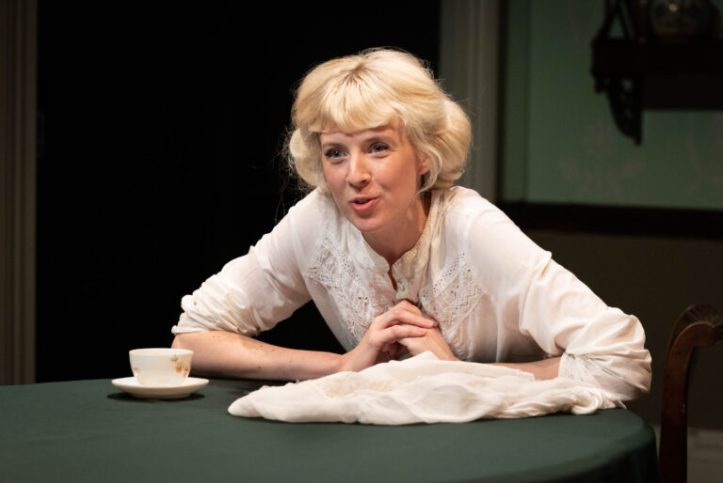
Makeshifts takes place in 1920s suburban London one evening. Sisters Carolne Parker (Philippa Quinn) and Dolly (Poppy Allen-Quarmby) talk about their respective days. From their conversation, we glean that a) they’re both unmarried; b) stuck in low paid work that offers little chance of improving their lot in life and c) there are very few men within their ‘social circle’ who they would remotely consider as suitable husband material, including their lodger, Henry Thompson (Akshay Sharan). Aside from their different vocations – with Dolly working as a school teacher, while Caroline stays at home looking after their mother and pretty much turning her hands to any manual chore for money – who they would choose to marry, if push comes to shove, differs.

Case in point: Albert Smythe (Joe Eyre). A bit of a ‘wide boy’ by today’s standards, Smythe’s cockiness stems from the fact that certain women would view him as a bona fide candidate as a husband for simply having a job and being reasonably well off. What’s ‘amazing’ is that while Caroline has convinced herself that Smythe is a ‘well-rounded person’, Dolly does the same when she thinks Smythe’s attentions have turned to her – despite the fact he’s also said that he found intelligent women ‘off-putting’ and preferred ‘homemakers’… Much like the first act of JP Priestley’s Time and The Conways, it is possible to gauge what the future holds for the characters by the narrowing of options at the close of the play…
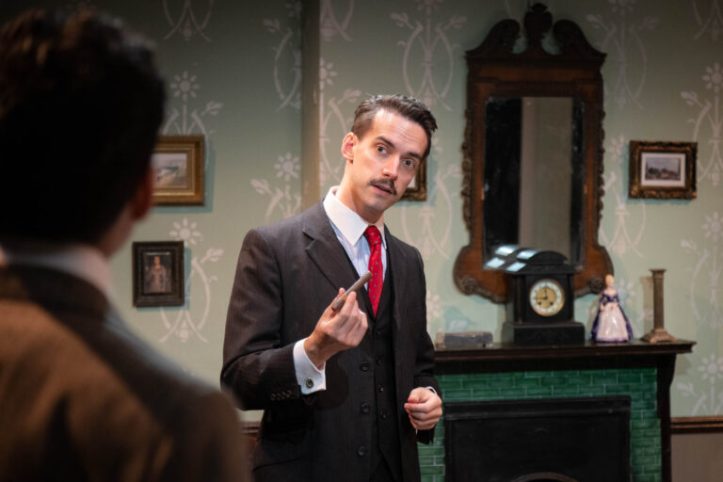
Realities takes place a few years later, where we meet Caroline once again – this time as a mother of a young child. In the intervening years, Caroline has settled down with Henry Thompson, the former lodger, though she is still eking out an existence. A surprise visit by Smythe’s wife Rose (Beth Lilly) reveals what the marriage and homelife is like for the Smythes. But it has to be said that each wife ends up being a ‘whetstone’ to the other, sharpening their resolve, while also showing materially or emotionally what the other lacks. And while it is obvious to the audience that for Caroline, Smythe ‘is the one that got away’ and wonders what life would have been like his wife, the revelations that take place bring her ‘dreams’ into focus…

Honour Thy Father takes places in Bruges, Belgium and much like the protagonists in Martin McDonagh’s film about the genteel town, the Morgan family are only there because of ‘exceptional circumstances’. Following Edward Morgan’s (Andrew Hawkins) bankruptcy, he uproots his wife Jane (Suzan Sylvester) and youngest daughter Madge (Beth Lily) to the Flemish capital. But even in a city that supposedly has ‘no society’ or culture to offer/spend money on, Edward is always broke and goes ‘cup in hand’ to his wife for ‘spending money’.

What ‘really’ turns the ‘natural order of things’ on its head is that Edward’s oldest daughter Claire (Poppy Allen-Quarmby) is the real breadwinner, even though ‘once upon a time’, he was against her working at all. And to add ‘salt into the wound’, Claire gives the money to her mother for safekeeping, mindful of her father’s predilection for gambling. It is, however, how Claire earns a living that becomes the crux of the play and whether ‘morality’ has any place in extreme situations, when one is doing everything one can to keep the family from homelessness…

While I’ve given a brief synopsis of the themes, the three plays are greater than the sum of their parts. There is much to savour during the evening, as everything that’s said – or unsaid – has meaning. Over time, the audience is naturally attuned to the minutiae of their lives and the ‘straws’ that become the final breaking point.
© Michael Davis 2023

Makeshifts and Realities runs at Finborough Theatre until Saturday 2nd September.
 Breaking The Fourth Wall