In every age there are chroniclers, those who write about different facets of society to varying degrees. While theatre criticsm has existed since time immemorial, critics who are almost as famous as the actors themselves are very much a 20th century phenomenon, some of whom had ‘larger-than-life’ personas… Written and directed by Gareth Armstrong, A Critical Stage is based on the last years of prominent theatre critic James Agate, who wrote prolifically between 1907 and 1947. Never shy to express an opinion, the certitude of his statements were unapologetic.
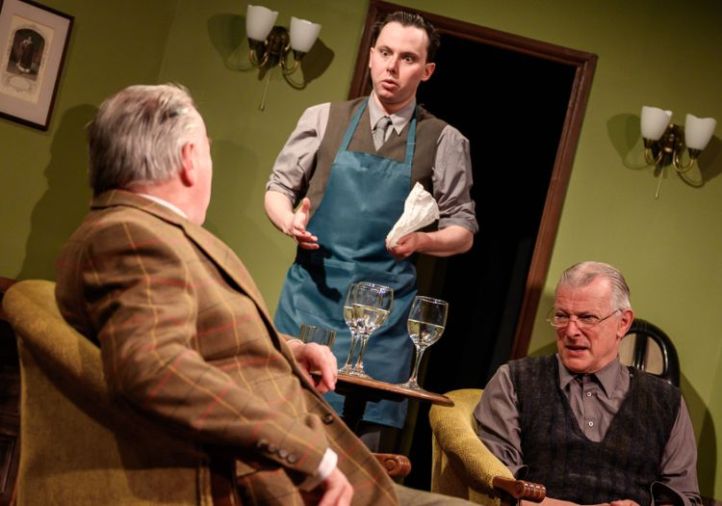
Played by Jeremy Booth, Agate is a Charles Laughton-esque figure who wherever he ‘hangs his hat’ holds court. At home, Agate has for company Smike (Sam Hill) his servant and Leo (David Acton) his ‘secretary’ who handles his correspondence and types up his dictations. Both have seen Agate ‘at his worst’ and are privy to the secrets of his ‘private life’. While some actors such as Gwen (Barbara Wilshire) would call Agate their friend, that doesn’t save them from his critical observations in a professional capacity – something she takes him to task with.
Be that as it may, one particular evening leaves Agate particulary embarrassed, but not half as much as the ramfications of the night out, with the police and his employer (The Sunday Times) getting involved…
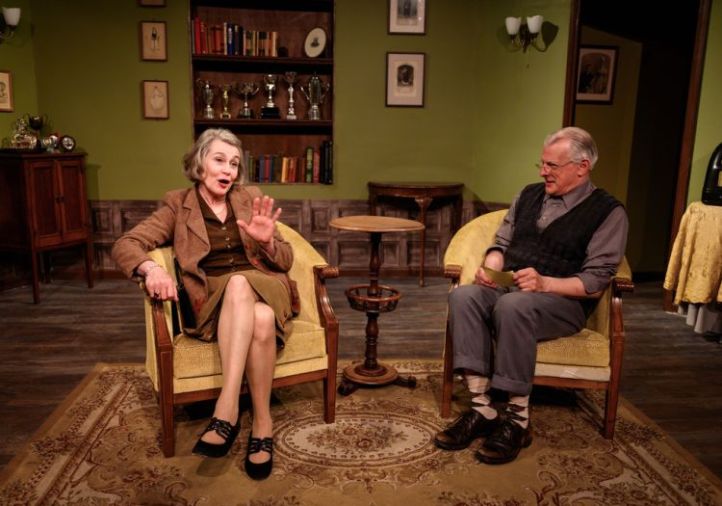
Wilshire’s Gwen is in many ways the most naturally likeable of the characters – for the most part forgiving of Agate’s faults, but from time to time calling him out when he has ‘crossed the line’. Through her we also see the longevity of women’s parts in theatre haven’t increased substantially in the past 100+ years. In contrast, Hill’s Smike rarely expresses any opinion, but is the epitome of discretion. However, that is not to say he isn’t unmoved by recent events or doesn’t expresses emotion. His microgestures are as covert as Agate’s are overt. As for Acton’s Leo, a gay Austrian Jew who has seen first-hand the rise of the Third Reich, he is generally sanguine about his lot in life, but from time to time the cracks in his armour begin to show…
Outside of the ‘plot’, the play does ask some very pertinent questions about the Arts and critiqing in general: for who do we write our observations for? Who cares what we think? And if you spend all your time looking at the ‘imperfections’ at what others have created, can you even enjoy the Arts in any capacity?

Agate’s sexuality (in this play at least) is a very important part of who he is and how he spends his time ‘after hours’. While much of it is touched upon in a light-hearted fashion, Agate’s predicament is in stark contrast to contemporaries Alan Turing who would eventually be arrested for his ‘activities’, and playwrights Terence Rattigan and Noel Coward, who were much more cautious in hinting at their proclivities.
For the most part, A Critical Stage adopts a light tone and accentuates the comedic elements of Agate’s life. While the play does touch upon the graver events that were happening during the Second World War, Agate’s world is very much a microcosm, untouched by the wants and cares that plagued the majority of people in wartime Britain.
© Michael Davis 2023

A Critical Stage runs at the Theatre at the Tabard until 17th June.
 Breaking The Fourth Wall